Material and profile fit, extruder configuration, capacity, energy efficiency, automation, production stability, supplier capability, and ROI drive every sound decision when you select an extrusion line for PVC window and door profiles. Dimensional accuracy, surface finish, and weathering performance all trace back to that choice. A 60 series profile and an 80 series profile demand different line sizes, so one specification rarely covers both. This framework gives you clear selection criteria for a PVC window profile extrusion line, and you can apply it during evaluation and negotiation. Use it to compare quotes on equal terms and to judge how each PVC extrusion setup will perform across its service life.
Key Takeaways
-
Match the extrusion line size to your largest profile to ensure efficient production.
-
Choose a twin screw extruder for PVC dry blend to achieve stable mixing and quality.
-
Check energy efficiency and automation features to reduce long-term costs.
-
Evaluate suppliers on technical expertise, testing, and after-sales support.
-
Calculate total cost of ownership, not just the purchase price, for a sound investment.
Anatomy of a Profile Extrusion Line
Core Components and Roles
Profile extrusion runs as one continuous process. A feeding system meters rigid polyvinyl chloride powder and additives into the extruder, where a screw melts, mixes, and pressurizes the compound. The die then shapes the melt into the profile cross-section. Next, vacuum calibration tables hold the soft extrudate to exact dimensions while water cooling solidifies it. Haul-off and cutting units pull the profile at a synchronized speed and cut it to length. A PLC and HMI tie every unit together, so temperatures, speeds, and alarms stay repeatable.
The plastic material is your first and most important selection factor. Raw material quality sets the ceiling on final uPVC profile quality before extrusion even begins. A well-matched PVC profile extrusion machine protects that quality; a mismatched one wastes it.

Single-Screw vs. Conical Twin Screw Extruder
PVC dry blend needs controlled plasticizing, stable mixing, and careful temperature control to limit degradation risk. For that reason, most PVC profile extrusion lines use a conical twin screw extruder or a parallel twin screw design. A twin screw extruder moves material by positive displacement, mixes intensively, and handles powder feedstocks well. Each twin screw extruder also gives you a narrow residence-time distribution, which supports consistent quality.
A single-screw extruder still fits clean, dry, pre-compounded materials that mainly need melting and forming. It costs less upfront and is simpler to maintain. Match the choice to your compound and profile complexity, not to a trend.
Line size follows profile size. A 60 series and an 80 series window profile need different line sizes, so confirm the fit before you compare quotes. Dual-strand or multi-strand configurations raise output from a single extruder, which suits a standard window profile line running high volumes of one family.
Industry Trends
Automation and Digital Monitoring
Automation now shapes how you evaluate a new line. Smart-extrusion platforms layer data analytics and connectivity on top of existing sensors, PLCs, and automation. Industry forecasts expect roughly 40% of new extrusion lines shipped globally to include digital monitoring or optimization by 2028. Embedded IIoT sensors track temperature, pressure, vibration, and throughput in real time. Full adopters report overall equipment effectiveness gains of 10–20% and scrap reduction of 30–50%.
| Trend | What It Delivers |
|---|---|
| Digital twins | Simulate process changes and train staff without stopping production |
| Machine vision | 100% inspection coverage at full line speed |
| Predictive maintenance | Forecast bearing, gearbox, and heater failures days to weeks ahead |
| AI process optimization | Adjust screw speed and temperature zones to hold quality while cutting energy and waste |
For North American PVC profile extrusion, robotic automation enhances material handling, loading, and inspection. Digital-twin adoption is projected to grow at a compound annual rate above 35% through 2030.
Energy Efficiency Expectations
Buyers now treat energy consumption as a headline specification, not an afterthought. A typical benchmark range runs 0.32–0.38 kW/kg, and lower is better. A drop from 0.38 to 0.32 kW/kg saves about $13,200 per year at 2 million pounds and $0.11/kWh. Combined hardware upgrades such as induction heating and closed-loop cooling push consumption below 0.25 kWh/kg. Induction heating replaces ceramic bands and cuts heat-up times by 30%.
Stable plasticization matters just as much. Green building codes like LEED v4.1 and the EU Energy Performance of Buildings Directive tighten efficiency and recycling requirements on fabricators. Precise calibration and cooling of multi-chamber profiles keep wall thickness and webbing geometry consistent, which protects the labeled U-factor. Ask suppliers for measured energy data on comparable PVC window profile runs, and verify plasticization stability during your trial.
Key Factors to Select an Extrusion Line
Capacity and Profile Range Fit
Start with your production volume and your profile range. These two numbers decide line size before price enters the conversation. Typical PVC window profile extrusion lines deliver 150 to 500 kg/h, and the table below shows how motor power maps to output.
| Extruder configuration | Motor power | Typical output (kg/h) |
|---|---|---|
| Conical twin screw (small) | 22 kW | 100–150 |
| Conical twin screw (mid) | 37 kW | 180–250 |
| Conical twin screw (large) | 55 kW | 300–400 |
| Parallel twin screw (YF240A) | 75 kW | 400–500 |
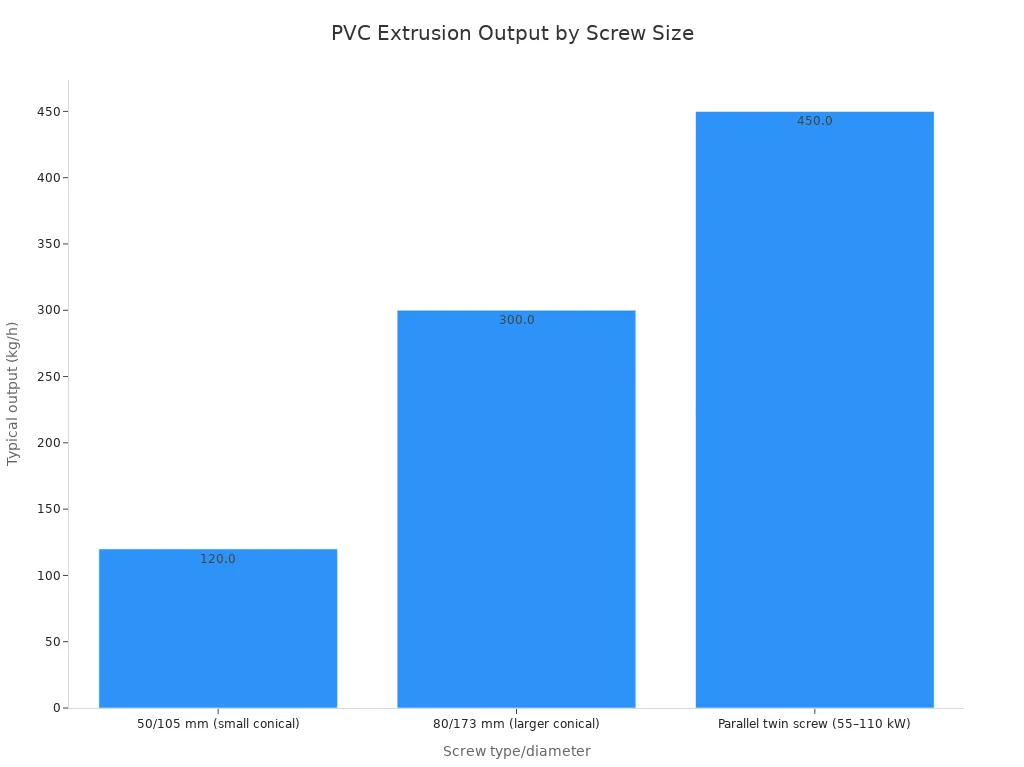
Profile series set a second limit. A 60 series profile runs on a smaller extruder and vacuum table. An 80 series profile needs a bigger capacity extruder, and the 88 series shares that same line with a mold change. Downstream sizing and hauling must match extruder output precisely. When you select an extrusion line, confirm the frame size against your heaviest profile, not your lightest.
Energy, Automation, and Control Integration
Design flexibility, automation, and low energy consumption belong in your selection criteria alongside capacity. A well-integrated control platform uses modern PLC and HMI technology with integrated drive and temperature management. Intelligent temperature control holds stable process conditions, and automatic parameter adjustment maintains consistent quality. Color-coded status indicators and startup safeguards cut operator error and speed up diagnostics.
Energy performance deserves the same scrutiny. Variable frequency drives match motor output to load, and insulated cast-aluminum barrel heaters trap heat during plasticization. Machine size matched to your target output rate avoids the waste of an oversized drive. Ask for measured consumption data on a comparable PVC profile extrusion run.
Control integration ties these threads together. Real-time monitoring of line operation lets one operator watch temperatures, speeds, and alarms from a single screen. That visibility supports a steady target output rate across shifts and shortens changeover time on a plastic profile production line.
Stable and Efficient PVC Profile Extrusion
Material Handling, Temperature, and Vibration Control
Stable plasticization starts upstream of the screw. You need consistent material flow into the extruder to avoid interruptions and defects. A steady feed rate keeps melt pressure even, and even melt pressure keeps wall thickness on target.
Temperature control carries that stability through the barrel and die. Hold optimal temperatures across every zone to prevent material degradation and protect product quality. The calibration and cooling section then decides how well the profile holds its shape. Cooling rate governs internal stress, dimensional stability, and surface quality. Overly fast cooling induces internal tension, while overly slow cooling harms throughput and geometry control. Immediately after the die, profiles enter a water bath or spray chamber. Rapid, uniform cooling holds shape, and vacuum sizing locks in precise dimensions while preventing warping. Your vacuum calibration tables must align with the die and haul-off, and a well-set vacuum calibration table prevents the sink marks that appear when vacuum pulls unevenly.

Vibration control completes the picture. PVC extrusion profiles dampen vibrations and reduce noise relative to metal components, which supports a more stable, quieter working environment. Mount the extruder on isolation pads and keep the haul-off synchronized to avoid chatter marks on the surface.
Efficiency-Boosting Features
| Efficiency Feature | How It Works | Where It Fits Best |
|---|---|---|
| Quick Mold Changeover | Quick-release clamping and modular calibration tables let technicians swap die heads and sizing molds fast, re-aligning water and vacuum connections quickly. | Window-system production with frequent shape changes between diverse orders |
| Co-Extrusion | A smaller secondary extruder applies a thin ASA or PMMA outer layer over base PVC for UV resistance and colorfastness inline. | Colored, weather-resistant frames where inline processing replaces separate lamination |
| Waste Reduction | Lines stabilize quickly at startup, and inline crushers grind saw scrap back into the mixing system. | High-end lines and smart factory layouts cutting raw-material waste |
Automation amplifies each feature. A central PLC with touch-screen monitoring of melt pressure, zone temperatures, and motor torque, plus recipe storage, eliminates manual dial adjustments and minimizes startup scrap. High-tier inverters let motors draw only the power the load requires, and ceramic insulated heater bands reduce heat loss. A well-matched upvc profile machine pairs these controls with a twin screw extruder sized to your heaviest profile, so your profile extrusion line runs at a steady target rate.
Supplier Evaluation and ROI
Technical Expertise, Testing, and Support
Judge a supplier on three fronts: engineering depth, testing discipline, and support after delivery. Ask whether the supplier designs dies in-house and runs flow simulation across multi-chamber cross-sections. Poor die design shows up later as wall thickness variation, warpage, and surface defects. Confirm the component list too. Siemens motors, ABB inverters, Omron temperature controllers, and Schneider contactors reduce electrical failure risk and simplify local spare parts sourcing.
| Evaluation Area | Key Criteria |
|---|---|
| Technical expertise | In-house die design, flow simulation, realistic output ratings |
| Testing capability | ISO 9001:2015 minimum, CE for European buyers, SGS reports, UL-listed components |
| After-sales support | Spare parts shipped within 48–72 hours, on-site commissioning and training |
Treat quoted output capacity with care. A line rated at 150 kg/h typically sustains 80–85% of that figure, so specify a rating above your usable target output rate. SKY WIN serves as one neutral benchmark here: 20+ years since 2004, 1,500+ clients, 43 countries, ISO 9001/CE/UL/SABER certification, 40+ R&D engineers, and on-site commissioning and training. Weigh every bid against similar proof.
ROI and Total Cost of Ownership
Price is the smallest part of the story. Build your business case on saleable kilograms, not nameplate ratings:
saleable kg/year = rated kg/h × operating hours × uptime × yield
A 500 kg/h line at 75% uptime and 94% yield delivers far less sellable material than its rating suggests. Model realistic changeover, maintenance, and demand assumptions before you sign.
Then total the full cost picture. Capital items include the machine, tooling, mixer, chiller, compressor, water treatment, power distribution, freight, duties, installation, training, floor preparation, and initial spares. Operating items include energy, labor, maintenance, scrap, changeover losses, and financing. Compare bids on total cost per saleable kilogram. The lowest purchase price can turn expensive through dimensional instability and returns, or through specialized parts that cause weeks of downtime.
Energy deserves its own line in the model. Multiply the quoted kW/kg by annual poundage and your local electricity rate. At two million pounds per year and $0.11/kWh, moving from 0.38 kW/kg to 0.32 kW/kg saves about $13,200 annually — nearly $200,000 over a 15-year equipment life. That figure can exceed the price gap between a basic and a premium extruder.
Automation savings compound the case. One main line running 6,000 hours per year, a 15% net output gain, one fewer operator per shift at a $30/hour burdened rate across three shifts (roughly $270,000 annually), plus 3% scrap reduction and about $18,000 in energy savings, typically produces payback in 18 to 24 months. Validate the claim with your own data: tally regrind pounds from the last three months, time an actual profile changeover, and annualize both. A disciplined pvc profile extrusion line purchase decision rests on this arithmetic, not on the quote sheet.
Selecting an extrusion line is a structured trade-off among material fit, capacity, efficiency, stability, automation, and supplier capability. No single specification settles the decision. Map your profile range and output targets against each factor, then size the line so peak demand runs below its rated limit. Validate every supplier through a factory acceptance test with your own molds and compound, plus reference checks with existing users. Treat documentation, commissioning, and training as contractual deliverables. Weigh price against total cost of ownership across the service life of your PVC profile production line. That arithmetic, not the quote sheet, measures a sound extrusion investment.
FAQ
Which line size suits a 60 series versus an 80 series profile?
Match the frame size to your heaviest profile. A 60 series profile runs on a smaller extruder and calibration table. An 80 series profile needs more capacity, and the 88 series shares that line with a mold change. Confirm the fit before you compare quotes.
What output should you expect from a PVC Window Profile Extrusion Line?
Typical lines deliver 150 to 500 kg/h, depending on screw configuration and motor power. Treat quoted capacity with care. A line rated at 150 kg/h usually sustains 80–85% of that figure, so specify a rating above your usable target.
How do you verify stability before you buy?
Run a factory acceptance test with your own compound and molds. Watch melt pressure, wall thickness, and surface finish across a full shift. Ask for measured energy data near 0.32–0.38 kW/kg on a comparable run. Stable plasticization shows up as consistent dimensions.
What support should a supplier provide after delivery?
Look for on-site commissioning, hands-on operator training, and spare parts shipped within 48–72 hours. Check credentials too. SKY WIN offers one benchmark: 20+ years since 2004, 1,500+ clients across 43 countries, and ISO 9001, CE, UL, and SABER certification.
How do you judge total cost of ownership?
Build your case on saleable kilograms, not nameplate ratings. Add energy, labor, maintenance, scrap, and changeover losses to the purchase price. Compare bids on cost per saleable kilogram. A low price can turn expensive through downtime and returns on a PVC Profile Production Line.