The better process for single-step vs. two-step WPC extrusion depends on production scale, product complexity, and cost constraints. Neither route is inherently superior. The short answer: single-step suits simple profiles and small-scale production, while two-step suits complex profiles and large-scale production. This comparison examines both routes across process design, technical performance, application fit, regulatory compliance, and cost. Readers can then match a process to their own wood plastic composite operation. Equipment choice, including the right WPC profile extrusion machine, follows from that match. Each route has a clear fit within modern WPC profile extrusion, and the sections below show where direct extrusion and two-stage compounding each perform best.
Key Takeaways
- Single-step extrusion works best for simple profiles and small production runs.
- Two-step extrusion suits complex profiles and large-scale production.
- Two-step extrusion gives better mixing control and consistent quality.
- Single-step extrusion saves on equipment cost and energy use.
- Match your machine to your product mix and production volume for success.
Compounding Then Extruding vs Direct One-Step Extrusion
The choice between compounding then extruding vs direct one-step extrusion comes down to how many times the material passes through a machine before it becomes a profile. One route mixes and shapes in a single pass. The other separates those jobs into two distinct stages.
How Direct One-Step Extrusion Works
Direct one-step extrusion is a continuous operation. Raw wood flour, polymer, and additives enter the machine, mix inside the barrel, and leave through a die as a finished profile. The industry also calls this route direct extrusion. No pelletizing stage interrupts the flow. Material moves from hopper to die without stopping, which keeps the line short and the startup quick. A single- and twin-screw extruders setup handles both the mixing and the shaping duty in this one-step approach. Die design matters here. Flow channels run larger and compression ratios stay lower to accommodate the fiber load. For this production route, manufacturers can review the WPC one-step profile extrusion line to see how direct extrusion equipment is configured.
How Two-Step Compounding and Extrusion Works
The two-step process begins with wpc compounding. Wood or natural fiber flour is first compounded with polyolefins, and the melt is pelletized. A typical wpc compounding and pelletizing sequence runs through five zones:
- Feed zone – deep-flighted elements convey solid material.
- Melting zone – kneading blocks plasticize the polymer.
- Mixing zone – distributive and dispersive elements disperse the wood filler.
- Venting zone – reverse-flighted elements remove moisture under vacuum.
- Metering zone – shallow-flighted elements build pressure for the die.
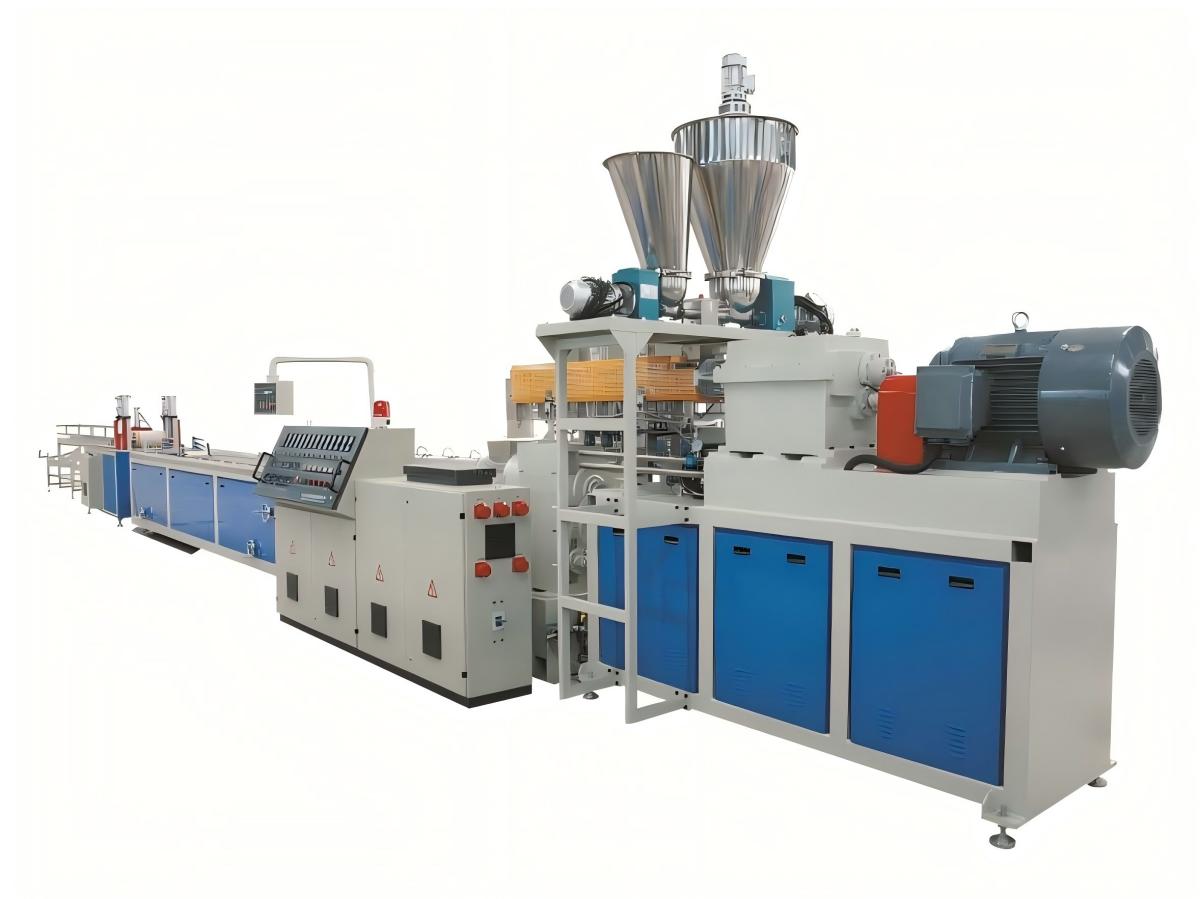
Barrel temperatures climb from 150–160°C at the feed to 180–200°C at metering, with screw speeds of 200–400 rpm. Pelletizing yields cylindrical pellets of 2–4 mm diameter. The second stage then performs profile extrusion of pre-compounded pellets into siding, decking, and similar shapes. In these lines, single screws serve a supporting role as the second machine rather than a standalone solution. Tandem extruders give better control over temperature, viscosity, and gas removal. This separation of compounding and product forming supports inventory management and quality checks before the WPC extrusion line runs the final profile. The WPC two-step conical twin-screw extrusion line is one equipment option for this production approach.
Technical Performance in WPC Extrusion
Technical performance separates the two routes in practical ways. Neither wins on every measure. The single-step vs. two-step wpc extrusion debate turns on mixing, output, and control. A fair wpc extrusion comparison shows each route has strengths. Buyers who read both sides can judge which fits their wood plastic composite operation and their wpc production technology goals.
Mixing Quality and Consistency
The two-step route gives compounding its own machine and its own screw geometry. Kneading blocks and dispersive elements work the melt hard. This design produces strong dispersion of the wood component in the plastic matrix. Moisture leaves through the venting zone under vacuum. The result is a uniform pellet batch. Every pellet carries the same fiber loading. Screw speed and barrel temperature stay steady across the batch, so pellet quality does not drift. The second stage then forms profiles from a feedstock with known properties. Consistency from run to run is a clear strength here. Operators can inspect pellets before the profile run starts. A bad batch stops at the pellet stage, not at the die.
Direct lines mix inside the same barrel that shapes the profile. Residence time is shorter. Shear history is less controlled. Simple formulations with moderate filler levels still mix well. High filler loadings test the limits of a single barrel. The extrusion process couples mixing and forming, so a mixing fault shows up directly in the profile. Both routes can meet quality targets in wpc profile extrusion. The two-step route holds an edge where formulation complexity rises. A direct line rewards careful die and screw design more than it rewards complex controls.
Output Rate and Process Control
Two-stage tandem setups split control into two independent zones. The first stage sets melt temperature and viscosity. The second stage sets profile dimensions and cooling. Gas removal happens in the first stage, away from the die. Each stage runs at its own optimum. The first stage can run hot and fast for melting, while the second stage runs cooler for shaping. This separation supports high output on complex profiles. Large plants running a wpc flooring production line often rely on this arrangement. A wpc profile extrusion machine in a tandem line can hold tight tolerances across long runs. Output climbs because neither stage waits on the other's duty.
Direct lines offer simplicity as their control advantage. Fewer setpoints mean fewer variables to tune. Continuous flow from hopper to die shortens startup and cuts scrap during changeover. Energy use per line stays modest. Output rates suit small and mid-scale production. A compact wpc extrusion line of this type needs less floor space and fewer operators. Operators need fewer skills to run a direct line well. A wpc profile extrusion machine on a direct line trades some mixing control for speed of changeover. Direct lines suit wpc profile extrusion at modest volumes.
Consistency differs in how faults are traced. A tandem line isolates a mixing problem to stage one. A direct line blends mixing and forming, so diagnosis takes more care. Neither pattern is better in absolute terms. The right pattern follows the product mix and the volume a plant needs. Buyers weighing wpc profile extrusion options should test both routes against their own formulations. Trials on wpc-based composite materials reveal which control pattern suits the shop floor. Modern production technologies of wpc composite materials accommodate either route when the line is specified well. Control choices in wpc extrusion shape the total cost of ownership. A wpc profile extrusion machine chosen for the wrong control pattern will underperform, whatever its build quality.
Application Fit for Each Process
Product type and run size decide which route fits a plant. The single-step vs. two-step wpc extrusion choice rarely hinges on machine quality alone. It hinges on what the line must make and how much of it.
Product Types and Profile Complexity
Simple profiles favor the one-step route. A straightforward deck board or a basic trim section carries a modest filler load and a plain cross-section. A direct line handles that duty well. Small runs of several simple shapes also suit this route. Startup is quick, and the line needs little floor space. A compact wpc extrusion line of this kind fits a shop with limited room and a varied order book.
Complex profiles favor the two-step process. Multi-chamber siding, hollow decking, and profiles with thin walls and tight tolerances demand stable melt quality. Pre-compounded wpc pellets give the second stage a feedstock with known fiber loading and known moisture content. The tandem arrangement then shapes the profile under separate temperature control. Large-scale production of such shapes rewards this split. A wpc profile extrusion machine on a tandem line holds dimensions across long campaigns. Plants running a wpc flooring production line often choose this route for the same reason: steady output of a demanding profile.
Customization and Changeover Flexibility
Changeover speed matters in custom work. A direct line changes from one simple profile to another with modest downtime. Fewer setpoints mean fewer adjustments. Operators reset the die and the temperature profile, then restart the continuous flow. Small batches of custom trim or edge profiles fit this pattern. The extrusion process stays short from hopper to die, so scrap during a changeover stays low.
The two-step route separates formulation from forming. A plant can hold several pellet formulations in stock and switch the second stage between them. Custom color or filler changes happen at the compounding stage, away from the profile die. This pattern suits a plant that runs many variants at high volume. A wpc profile extrusion machine in this setup supports faster product changeovers at the formulation level. The trade-off is more inventory and more planning. Neither pattern is better in absolute terms. A shop with many small custom orders leans toward direct extrusion. A plant with a broad catalog and large volumes leans toward the two-stage route.
Application fit also depends on the material family. Wood plastic composite formulations with high filler content test a direct line's mixing capacity. A two-stage line absorbs that load more comfortably. Buyers should map their product list against each route before choosing a wpc profile extrusion machine. Trials on the actual profile settle the question faster than any specification sheet. The right wpc profile production pattern follows the order book, not the other way around.
Compliance and Material Consistency
Material Consistency and Traceability
Consistent formulation starts with controlled mixing. High-shear, intermeshing twin-screw mixing produces a homogeneous blend of wood flour, thermoplastic polymer, and additives. Precise temperature control at every stage prevents degradation and holds properties uniform. Continuous checks on temperature, pressure, and consistency run throughout the line. Finished profiles are then inspected for evenness, dimensional accuracy, and surface finish. Only products meeting strict standards leave the factory.
Traceability follows a defined chain in both routes:
- Raw materials are tested against benchmarks before use.
- Extrusion parameters are monitored along the line to detect abnormalities.
- Finished goods are inspected for evenness, dimensional accuracy, and surface finish.
- Mechanical and physical tests cover tensile strength, impact resistance, and thermal stability.
- Records of all QC tests are kept to track uniformity and enable traceability.
Regrind control matters for wpc extrusion. A regrind blending system should feed consistently rather than rely on manual batch mixing. Gravimetric feeding gives precise control for tight blend ratios. The regrind ratio should be measurable and repeatable. Scrap is separated by formulation and source, such as white profile scrap or colored scrap, to preserve traceability. For PVC recycled material, traceability can matter as much as the regrind percentage itself.
Meeting Safety and Quality Standards
Both routes can meet recognized standards when the line is specified well. ASTM D7032 sets U.S. performance ratings for wpc deck boards and related products. EN 15534-4 covers exterior wpc decking profiles. ISO 178 governs flexural testing, and ISO 4892 covers UV weathering. Dimensional tolerance, moisture absorption, and slip resistance each trace back to process control. Die geometry, calibrator alignment, haul-off speed, and cooling uniformity drive board-level conformity.
The two-step route supports compliance through separated control. A high-speed twin-screw compounding stage homogenizes additives and fillers. A low-speed single-screw shaping stage avoids over-shearing and holds temperature variance to plus or minus 1 degree Celsius. That stability supports demanding standards such as ISO 10993 for soft PVC medical materials. A wpc profile extrusion machine on a tandem line can hold tight tolerances across long runs. Direct lines meet the same standards on simpler profiles, where a single heat cycle lowers cumulative thermal history on the wood fiber. Either wpc profile extrusion route can satisfy quality targets for wood plastic composite products. Buyers should confirm that the chosen wpc profile extrusion machine and its QC records match the standards their market requires.
Cost and WPC Profile Extrusion Machine Selection
Equipment and Startup Costs
Budget and scale decide where each route fits. A one-step wpc extrusion line needs one machine rather than two. Raw powder blends feed straight into the profile extruder, which mixes, degasses, and shapes in a single barrel. Total equipment cost falls, and startup is simpler. The trade-off is a higher process burden on that machine. A one-step line needs robust gravimetric or volumetric feeding and a twin-screw extruder with strong mixing and venting. A wpc profile extrusion machine built for this duty costs more than a basic unit, yet the plant buys only one.
The two-step route adds a compounding stage and a pelletizing line. Upfront cost rises accordingly. Screw type drives much of the difference:
| Extruder type | Upfront cost | Maintenance demand | Operating implications |
|---|---|---|---|
| Single-screw | Lower | Less maintenance | Limited mixing and output consistency for complex blends |
| Twin-screw | Higher | — | Superior mixing, higher output, better consistency |
A wpc profile extrusion machine with a twin-screw build costs more. Its mixing and output often justify the investment. Manufacturers such as SKY WIN supply both configurations, so the choice stays with the buyer's process. Buyers can compare the WPC extrusion equipment range to evaluate available line configurations.
Operating and Maintenance Costs
Energy use favors the one-step route. Eliminating compounding avoids the energy needed to re-melt pre-compounded wpc pellets. A wpc extrusion line of this type also runs with fewer operators. Maintenance demand stays moderate, though the single barrel carries the full mixing load. A wpc profile extrusion machine on this route rewards careful feeding control and a solid venting design.
The two-step route spreads the load across two machines. Each stage runs at its own optimum, which supports steady wpc profile production at high volume. Energy use per line is higher. Maintenance covers two machines, yet each one works under gentler conditions. A wpc profile extrusion machine line of this kind suits large plants. Energy-efficient models cut operating costs on either route. Reliable technical support and easy spare-parts access reduce downtime. A wpc profile extrusion machine chosen for the right scale protects long-term profitability. Buyers should weigh wpc profile extrusion costs against output, not against price alone. The wpc extrusion process, the wpc profile extrusion machine, and the wpc profile extrusion machine line must all match the budget. A wpc profile extrusion machine that fits the order book serves better than a cheaper mismatch. Every wpc profile extrusion decision starts with scale.
Process design, mixing quality, output control, application fit, compliance, and cost all point the same way. The single-step vs. two-step wpc extrusion decision rests on production scale, product complexity, and budget priorities. Neither route wins outright. Each serves a different shop floor.
A simple guide helps:
- Simple profiles and small runs: lean toward single-step extrusion.
- Complex profiles and large-scale output: lean toward two-step wpc extrusion.
Both routes support reliable wpc profile production and consistent wood plastic composite quality. Match the wpc profile extrusion machine to the order book, confirm the wpc profile extrusion line meets your standards, and let wpc profile extrusion follow that match.
FAQ
Which process suits a first-time WPC producer?
A single-step line needs one machine and a simpler startup. A new producer with simple profiles and modest volumes can begin there. A two-step route adds a compounding stage and higher upfront cost. Match the wpc profile extrusion machine to the order book before committing capital.
How does moisture control differ between the two routes?
The two-step route removes moisture in a dedicated venting zone under vacuum during compounding. A direct line vents inside the same barrel that shapes the profile. Both approaches work. The separated stage gives operators a clearer checkpoint before the wpc profile extrusion run begins.
Can a two-step line run simple profiles economically?
Yes. A two-step line handles simple shapes well, though the extra stage adds cost at low volume. A wpc profile extrusion machine line built for tandem operation suits plants with a broad catalog. Small shops with plain profiles usually find direct extrusion more economical for wpc profile extrusion.
What should buyers test before selecting a machine?
Run the actual formulation on both routes. Check mixing quality, output stability, and dimensional tolerance on the real profile. Confirm the wpc profile extrusion machine meets the standards your market requires, such as ASTM D7032 or EN 15534-4. Trials settle the wpc extrusion question faster than specifications.
Does profile complexity change the maintenance burden?
Complex profiles demand tighter control, and a tandem setup spreads that load across two machines. Each machine then works under gentler conditions. A direct line carries the full duty in one barrel. Either wpc extrusion approach stays reliable when the wpc profile extrusion machine is specified for its duty.