dyyseo
Water Cooled Screw Chiller

2025 Guide to Water Cooled Screw Chiller vs Air Cooled Chiller for Industry

2025 Guide to Water Cooled Screw Chiller vs Air Cooled Chiller for Industry

If you want the most efficient cooling for large-scale industrial operations in 2025, you should consider a Water Cooled Screw Chiller. This chiller type remains the preferred choice for high thermal output needs, holding 59.5% market share in 2024. You need to weigh key factors such as cost, energy efficiency, installation space, maintenance, environmental impact, water use, noise, and suitability for your industry and location.


Factor

Water-Cooled Chillers

Air-Cooled Chillers

Cooling Capacity

More suitable for larger cooling needs

Better for smaller to medium applications

Installation Space

Requires indoor placement with cooling towers

Can be installed outdoors, saving indoor space


Quick Comparison

Water Cooled Screw Chiller


Water Cooled Screw Chiller vs Air-Cooled Chiller

Choosing the right chiller for your facility depends on several important factors. You want to compare water cooled screw chillers and air-cooled chillers side by side to see which fits your needs best. Below, you will find a summary table that highlights the main differences. This table helps you quickly scan the features that matter most for industrial cooling in 2025.

Factor

Water Cooled Screw Chiller

Air-Cooled Chiller

Initial Cost

Higher due to cooling tower and piping

Lower, simple installation

Energy Efficiency

High, especially in large-scale operations

Moderate, best for small to medium setups

Installation

Needs indoor space and water supply

Outdoor installation, saves indoor space

Maintenance

Regular water treatment and tower upkeep

Simpler, less frequent maintenance

Environmental Impact

Uses water, but supports eco-friendly refrigerants

No water use, may have higher energy demand

Water Use

Requires reliable water source

No water needed

Noise

Operates quietly indoors

Fans can create more noise outdoors

Lifespan

Long, with proper maintenance

Moderate, depends on environment

Suitability

Best for large, high-temperature industries

Ideal for smaller, space-limited sites


You should also consider operational characteristics. Water cooled screw chillers perform well in high-temperature environments and offer precise cooling. Air-cooled chillers work best where water is scarce or installation space is limited. Your final choice depends on your cooling capacity requirements and the environmental conditions at your site.


How They Work


Water Cooled Screw Chiller Operation

You will find that a water cooled screw chiller uses water as the main medium to remove heat from your process. The system pumps water through a sealed condenser, where it absorbs heat from the refrigerant. This heated water then travels to a cooling tower, where it releases the heat into the atmosphere. The cooled water returns to the chiller, and the cycle repeats.

Modern water cooled screw chillers often include advanced features that enhance performance and efficiency. For example, a double compressor system allows the chiller to handle larger loads with greater stability. You can benefit from a PLC control system, which provides smart monitoring and easy adjustments through a touchscreen interface. These controls let you track system diagnostics, log historical data, and even access the chiller remotely. Many models use eco-friendly refrigerants, which help reduce environmental impact while maintaining high efficiency.


Air-Cooled Chiller Operation

An air-cooled chiller works differently. Instead of using water, it relies on fans to blow air across exposed condenser tubes. The refrigerant inside these tubes releases heat, which the moving air carries away. This process makes air-cooled chillers easier to install, since you do not need a cooling tower or extra piping.

You can place an air-cooled chiller outdoors, such as on a rooftop or beside your facility. This setup saves indoor space and reduces installation complexity. However, air is less effective than water at absorbing heat, so air-cooled chillers may not match the efficiency or performance of water cooled screw chillers for large industrial loads.


Feature

Water-Cooled Chillers

Air-Cooled Chillers

Efficiency

More efficient for large loads due to water's heat capacity

Less efficient, relies on air which is less effective

Space Requirements

Requires mechanical rooms and cooling towers

Requires less space, can be placed on rooftops

Maintenance Needs

Higher maintenance due to more equipment

Lower maintenance due to simpler design

Service Life

Generally longer due to indoor placement

Shorter due to exposure to environmental elements


Water Cooled Screw Chiller Pros and Cons
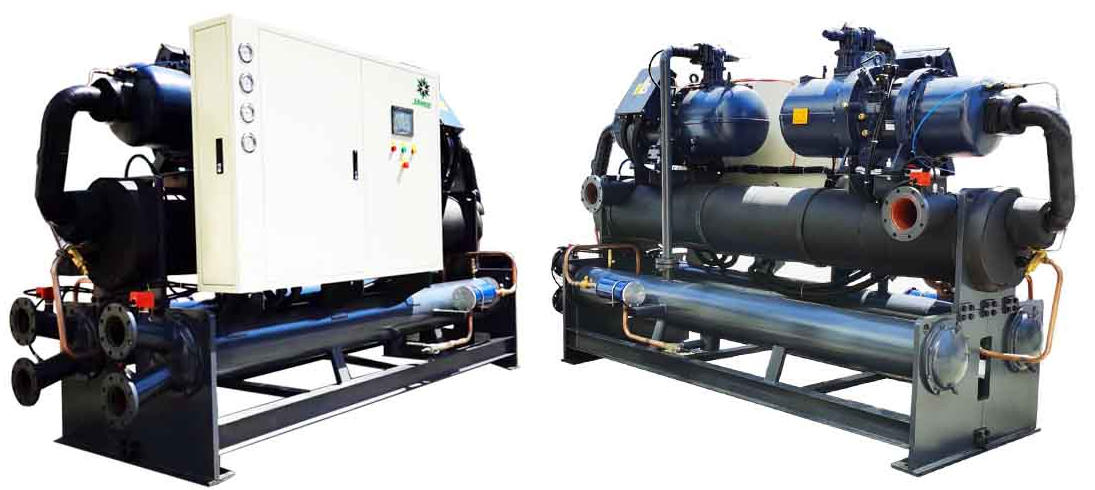
Air Cooled Chiller for Industry


Advantages

You gain several benefits when you choose a water cooled screw chiller for your industrial facility.

  • You achieve high energy efficiency, especially in large-scale operations. Many water cooled screw chillers reach COP values up to 4.98 and IPLV ratings as high as 6.67.

  • You control temperature with precision. Stepless capacity modulation lets you adjust cooling from 0 to 100%, so you match your process needs exactly.

  • You enjoy advanced safety features. Modern water cooled screw chillers include multiple protection devices, such as over-temperature and pressure safeguards.

  • You benefit from reliable performance in demanding environments. These chillers handle capacity ranges from 50 to over 1,000 tons, making them ideal for industries like plastic manufacturing and concrete mixing.

  • You extend the lifespan of your equipment. Indoor placement shields the chiller from weather, which helps maintain efficiency and reduces long-term costs.


Disadvantages

You should consider some challenges before installing a water cooled chiller.

  • You face installation complexity. Proper planning and execution are crucial for setting up a water-cooled chiller. You need to follow a step-by-step guide to ensure efficient operation and system longevity.

  • You must manage water requirements. Untreated water can cause higher condenser pressures and lower heat transfer efficiency. You need chemical treatments to keep the system running smoothly.

  • You take on regular chiller maintenance tasks. Tube cleaning is essential for optimal heat transfer. You also need to analyze and change compressor oil. Maintaining flow rates between 3 to 12 feet per second helps prevent operational issues.

  • You invest more upfront. The initial cost is higher due to the need for cooling towers and extra piping, but you may save on operating costs over time.

Water-cooled chillers suit large facilities with reliable water sources and skilled maintenance teams. If you want top chiller efficiency and precise control, this type of chiller meets your needs.


Air-Cooled Chiller Pros and Cons


Advantages

You will find that air-cooled chillers offer several practical benefits for industrial settings. These systems stand out for their straightforward installation process. You do not need to set up cooling towers or complex plumbing, which helps you save both time and money. Many facilities choose air-cooled chillers because they can be placed outdoors, freeing up valuable indoor space for other equipment or operations.


Maintenance tasks are also simpler. You avoid the need for water treatment systems and the frequent upkeep required by cooling towers. This means you spend less time and resources on regular maintenance.


Here is a quick overview of the most commonly cited advantages:

Advantage

Description

Lower Installation Costs

No need for cooling towers or extra plumbing, making installation more affordable.

Simplified Maintenance

Fewer components mean easier and less frequent maintenance.

Smaller Footprint Indoors

Outdoor installation frees up indoor space for other uses.

No Water Consumption

Perfect for areas with water restrictions or high water costs.


Disadvantages

You should also consider some limitations before choosing an air cooled chiller. These systems often have lower energy efficiency compared to water-cooled models, especially when you need to cool large industrial loads. Air, as a cooling medium, cannot absorb as much heat as water, so the system may use more electricity to achieve the same cooling effect.

Noise can be another concern. Air-cooled chillers use large fans to move air across the condenser coils. These fans can generate noticeable noise, especially when the chiller operates at full capacity. If your facility is located near offices or residential areas, you may need to plan for noise reduction measures.


Key Comparison Factors


Cost

You need to consider both initial and ongoing costs when choosing a chiller. Water cooled screw chillers usually require a higher upfront investment. You pay for the chiller itself, a cooling tower, and extra piping. Installation takes longer because you must set up a continual water source and allocate space for additional equipment. Air-cooled chillers cost less to install. You can place them outdoors and avoid the expense of a cooling tower. Over time, water cooled screw chillers may save you money through lower energy bills, especially in large facilities. Air-cooled chillers often have higher operating costs in hot climates due to lower efficiency.


Energy Efficiency

You want your chiller to deliver strong performance while using less energy. Water cooled screw chillers excel in energy efficiency. Water absorbs heat better than air, so these chillers use less electricity to cool large loads. Advanced models feature eco-friendly refrigerants and PLC controls that optimize operation. Air-cooled chillers work well for small to medium applications but may consume more energy in high-temperature environments. If you run a large industrial process, you benefit from the superior efficiency of water cooled screw chillers.


Installation

You must plan for installation requirements before making a decision. Water cooled screw chillers need indoor space and a reliable water supply. You also install a cooling tower, which adds complexity and time to the project. Air-cooled chillers are stand-alone units. You can install them quickly outdoors, saving valuable indoor space. If you want a faster setup, air-cooled chillers offer a clear advantage.


Maintenance

You should prepare for regular maintenance to keep your chiller running smoothly. Water cooled screw chillers require more attention. You need to treat water to prevent corrosion and clogs. You also clean tubes and monitor water quality. Air-cooled chillers have fewer components, so maintenance is simpler. You mainly check refrigerant levels and clean condenser coils.

Issue

Description

Solutions

Low Refrigerant Levels

Ice may form if refrigerant levels drop too low.

Regularly check and top up refrigerant levels.

Water Flow Issues

Inadequate water flow can lead to ice buildup.

Ensure proper maintenance and check for blockages.

Malfunctioning Sensors

Faulty temperature sensors can prevent proper operation.

Replace faulty sensors to avoid ice buildup.

Water Quality Issues

Hard water and contaminants can damage components and reduce efficiency.

Implement a water treatment system and regularly monitor water quality.

Improper Operation

Operating outside recommended parameters can cause wear and failure.

Avoid overloading and ensure settings align with manufacturer recommendations.

Power Fluctuations

Voltage spikes can harm electrical components.

Use voltage regulators and conduct regular inspections of electrical systems.

  • Corrosion can lead to leaks and damage if you do not treat water properly.

  • Poor maintenance may result in clogs and reduced efficiency.


Lifespan

You want your chiller to last as long as possible. Water cooled screw chillers often have a longer lifespan. Indoor placement protects them from weather and temperature swings. You extend their life with regular maintenance and water treatment. Air-cooled chillers sit outdoors, so they face rain, dust, and heat. These conditions can shorten their service life. If you prioritize durability, water cooled screw chillers offer better long-term value.


Environmental Impact

You need to think about how your choice affects the environment. Water cooled screw chillers use water, but many modern models run on eco-friendly refrigerants. Advanced controls help reduce energy use and emissions. Air-cooled chillers do not consume water, which makes them suitable for regions with water scarcity. However, they may use more electricity, especially in hot climates, which can increase your carbon footprint.


Water Use

You must evaluate water consumption before selecting a chiller. Water cooled screw chillers require a steady supply of water. Usage varies by city and climate. For example, annual water consumption per ton ranges from 1.1 kGal in Minneapolis to 4.1 kGal in Phoenix.

Bar chart comparing annual water consumption and per ton water use for chillers across eight cities

Air-cooled chillers do not use water, making them ideal for facilities in water-restricted areas.


Noise

You should consider noise levels, especially if your facility is near offices or residential zones. Water cooled screw chillers operate quietly indoors, with noise levels between 55 and 65 decibels. This is similar to a conversation or background music. Air-cooled chillers produce more noise, ranging from 70 to 80 decibels, which you can compare to a vacuum cleaner or a busy street.

Chiller Type

Noise Level (dB)

Description

Air-Cooled Chillers

70 to 80

Comparable to a vacuum cleaner or busy street

Water-Cooled Chillers

55 to 65

Similar to a conversation or background music


Suitability by Industry


Large-Scale Manufacturing


You should choose a water cooled screw chiller for large-scale manufacturing. Industries such as plastics, chemicals, and concrete production rely on these chillers for their broad capacity coverage and reliable load-following performance. Market reports show screw chillers hold a 38.3% share in these sectors, with centrifugal chillers gaining momentum due to efficiency and reduced maintenance needs.

Chiller Type

Market Share

Key Features

Screw Chillers

38.3%

Broad capacity, reliable operation

Centrifugal Chillers

Gaining

High efficiency, low maintenance

  • Screw chillers offer cost-effectiveness and low maintenance.

  • You see them most often in plastics, chemicals, and pharmaceuticals.


Medium & Small Facilities

For medium and small facilities, you need to focus on operational efficiency and cost-effectiveness. Chillers with capacities between 50 and 200 tons fit these operations well. You should consider the layout and available space in your facility, as well as the need for precise temperature control.

Factor

Description

Cooling Capacity

50-200 tons commonly used

Energy Efficiency

Critical for selection

Installation Environment

Facility layout and space influence suitability

Application Requirements

Food & beverage, pharmaceuticals, chemicals drive demand

  • You benefit from chillers that maintain precise temperature and offer easy installation.


Water-Restricted Locations

If your facility is in a water-restricted area, you should select an air-cooled chiller. These chillers do not require a water supply or cooling tower, making them ideal for remote sites or regions with limited water resources.

When to Use Air-Cooled Chillers

Why It Makes Sense

Remote or water-scarce locations

No need for water supply or cooling towers

Projects needing fast deployment

Easier to install, no water piping required

Tight budgets

Lower initial investment

Urban environments with space limits

Rooftop-ready, compact size

Air-cooled chillers help you avoid water costs and simplify installation.


High Temperature Areas

In high temperature industrial areas, you should rely on water cooled screw chillers. Water has higher thermal conductivity than air, so these chillers deliver greater cooling efficiency and stable performance. You also experience quieter operation because they do not depend on large fans.

Feature

Water-Cooled Chillers

Air-Cooled Chillers

Cooling Efficiency

Greater

Less efficient in hot climates

Noise Level

Quieter

Noisier due to fan operation

Performance in Hot Climates

Consistent and stable

Struggles with efficiency


Urban vs Remote Sites

You need to consider site conditions when choosing a chiller. In urban environments with limited space, air-cooled chillers fit well on rooftops and offer a compact footprint. For remote sites or projects needing fast deployment, air-cooled chillers provide easy installation and lower initial costs. Water-cooled chillers consistently outperform air-cooled systems in environments demanding high efficiency and stable operation, such as large-scale manufacturing or a data center.

  • Choose air-cooled chillers for space-limited urban sites or remote locations.

  • Select water-cooled chillers for high-capacity, efficiency-driven projects.


2025 Trends for Water-Cooled Chillers


Energy-Saving Tech

You will see major advances in energy-saving technology for water cooled screw chillers in 2025. Manufacturers now use variable speed drives and compressors, which let your chiller adjust its output based on cooling demand. This feature helps you achieve greater energy efficiency and higher efficiency during peak and off-peak hours. Advanced heat exchanger designs improve heat transfer, so your water cooled chiller uses less energy. Many systems now include closed-loop cooling and hybrid cooling, which combine wet and dry methods to reduce water use. You can also benefit from free cooling and heat recovery, which capture waste heat for other applications.

Feature

Description

Variable Speed Drives

Adjust operation for optimal energy use

Advanced Heat Exchangers

Boost heat transfer, lower energy needs

Hybrid Cooling

Mixes wet and dry cooling to save water

Free Cooling

Uses ambient air to reduce compressor energy

Heat Recovery

Captures waste heat for heating


Smart Controls

You can now control your water-cooled chiller with smart technology. PLC controllers and microprocessor systems monitor every function and keep your chiller running smoothly. Touch screen interfaces make operation simple and give you detailed alarm information for troubleshooting. Intelligent control systems allow remote monitoring, so you can track performance from anywhere. Automation features help you maintain precise temperature control, which is vital for data center cooling and other sensitive environments.

Feature

Description

PLC Controller

Delivers temperature accuracy within ±0.5 degrees

Touch Screen Interface

Offers intuitive operation and alarm details

Remote Monitoring

Enables real-time performance tracking

Predictive Maintenance

Uses AI to prevent failures and optimize efficiency


Eco-Friendly Refrigerants

You will notice a strong shift toward eco-friendly refrigerants in water-cooled chillers. Companies now use refrigerants with lower global warming potential to meet new regulations and sustainability goals. These refrigerants support green building standards and help you lower your carbon footprint. Manufacturers also focus on sustainable materials and processes, so your chiller meets environmental requirements. The rise of adaptable, cost-effective cooling solutions means you can choose a water cooled screw chiller that fits your needs and supports environmental responsibility.

  • Lower GWP refrigerants reduce environmental impact.

  • Sustainable manufacturing supports green building trends.

  • Hybrid chillers offer flexible, efficient cooling.


Regulatory Updates

You must stay informed about new regulations affecting water-cooled chillers. In 2025, stricter standards require you to use chillers that meet ASHRAE and LEED guidelines. These rules encourage the use of eco-friendly refrigerants and energy-saving technologies. You need to ensure your chiller complies with local and international standards to avoid penalties and support sustainability. Manufacturers now design chillers with advanced safety protections, including over-temperature and pressure safeguards, to meet these requirements.


OUMAL Chiller is a cooling tower and chiller system manufacturer integrating R&D,manufacturing and customization.Provide professional solutions.15+ years of work experience!
阅读全文......

Which Is Better for Your Business Air Cooled Screw Chiller or Water Cooled Chiller

Which Is Better for Your Business Air Cooled Screw Chiller or Water Cooled Chiller

You should pick a chiller that fits your business. Air Cooled Screw Chiller is good for small areas. It does not need much care. Water-cooled units work best in big places. They are more efficient.

  • Water-cooled chillers have about 60% of the market in 2024. They are used mostly for large businesses.

  • Air-cooled models are growing quickly because they are easy to set up.


Cost of Air Cooled Screw Chiller vs Water Cooled Chiller

Upfront Costs

Air cooled screw chillers usually cost less at first. They have a simple design. They do not need cooling towers or extra parts. This makes them cheaper to buy. Here is a table that shows how much air cooled chillers can cost:

Chiller Type

Cost Range

Air-Cooled Chiller

$5,000 - $50,000+

Mid-Sized Air-Cooled

$25,000 - $26,000 total

Water-Cooled Chiller

Not specified in detail


Many things change the price of each chiller. You should think about the cooling method, compressor type, and control system. The next table explains these things:

Factor

Description

Cooling method

Air-cooled chillers are cheaper and easy to put in. Water-cooled chillers need more equipment.

Compressor type

Screw compressors cost more than scroll compressors for big systems.

Control system

Better controls make both types cost more.


Operating Expenses

Water cooled chillers use less electricity. They work better and save energy. Air cooled chillers use more power, especially when it is hot. If you want to save money every month, water cooled chillers can help. But you also need to pay for water and chemicals for water cooled chillers.


Maintenance Costs

Air cooled chillers are easy to take care of. You just need to clean the coils. You do not need to treat water. Water cooled chillers need more work. You must treat the water and clean the tubes. You also need to check the parts inside. Air cooled chillers are easier to keep up over ten years. Water cooled chillers last longer, sometimes up to 30 years. You might pay more to keep water cooled chillers running, but they can work for a long time.

Tip: If you want less work and lower costs, pick an air cooled screw chiller for your business.


Comparison of Air-Cooled and Water-Cooled Chillers Efficiency

Performance in Different Climates

You should think about your local weather before choosing a chiller. Each chiller type works differently in hot or cold places. Air-cooled chillers do not work as well during heatwaves. When it gets hot outside, they must work harder. Their performance goes down. In cold places, air-cooled chillers also lose some efficiency. They do not work as well at part load.

Water-cooled chillers do better in hot weather. They keep working well even when it is very warm. These chillers can run at lower condensing pressures. This helps them stay efficient. In cold places, water-cooled chillers still work well. They often use less energy than air-cooled chillers.

Chiller Type

Performance in Hot Climates

Performance in Cold Climates

Air-Cooled Chillers

Not as efficient, affected by heatwaves

Efficiency drops at part load, not as good

Water-Cooled Chillers

More efficient, steady in high temperatures

Usually more efficient, works well in cold


Energy Efficiency

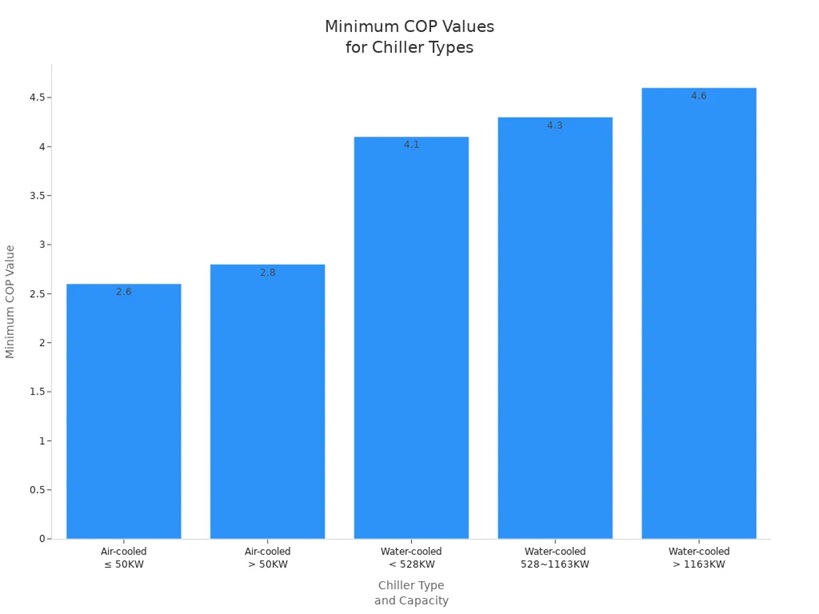
You want your chiller to use less energy. Water-cooled chillers are usually more efficient than air-cooled chillers. The coefficient of performance (COP) shows how well a chiller uses energy. A higher COP means the chiller is more efficient.

Chiller Type

Rated Cooling Capacity

Minimum COP Value

Air-cooled screw chillers

≤ 50KW

2.60

Air-cooled screw chillers

> 50KW

2.80

Water-cooled screw chillers

< 528KW

4.10

Water-cooled screw chillers

528~1163KW

4.30

Water-cooled screw chillers

> 1163KW

4.60


You can also check the energy efficiency ratio (EER) to compare chillers. Water-cooled chillers have an EER of 3.5. Air-cooled chillers have an EER of 2.8. This means water-cooled chillers save more energy over time.

Chiller Type

Energy Efficiency Ratio (EER)

Air-Cooled Chiller

2.8

Water-Cooled Chiller

3.5

Screw Chiller

3.7

If you compare air-cooled and water-cooled chillers, you see water-cooled chillers are more efficient. They work better in most climates. Air-cooled chillers are best in cooler places or where water is hard to find.


Space and Installation for Air-Cooled Chiller and Water-Cooled Chiller

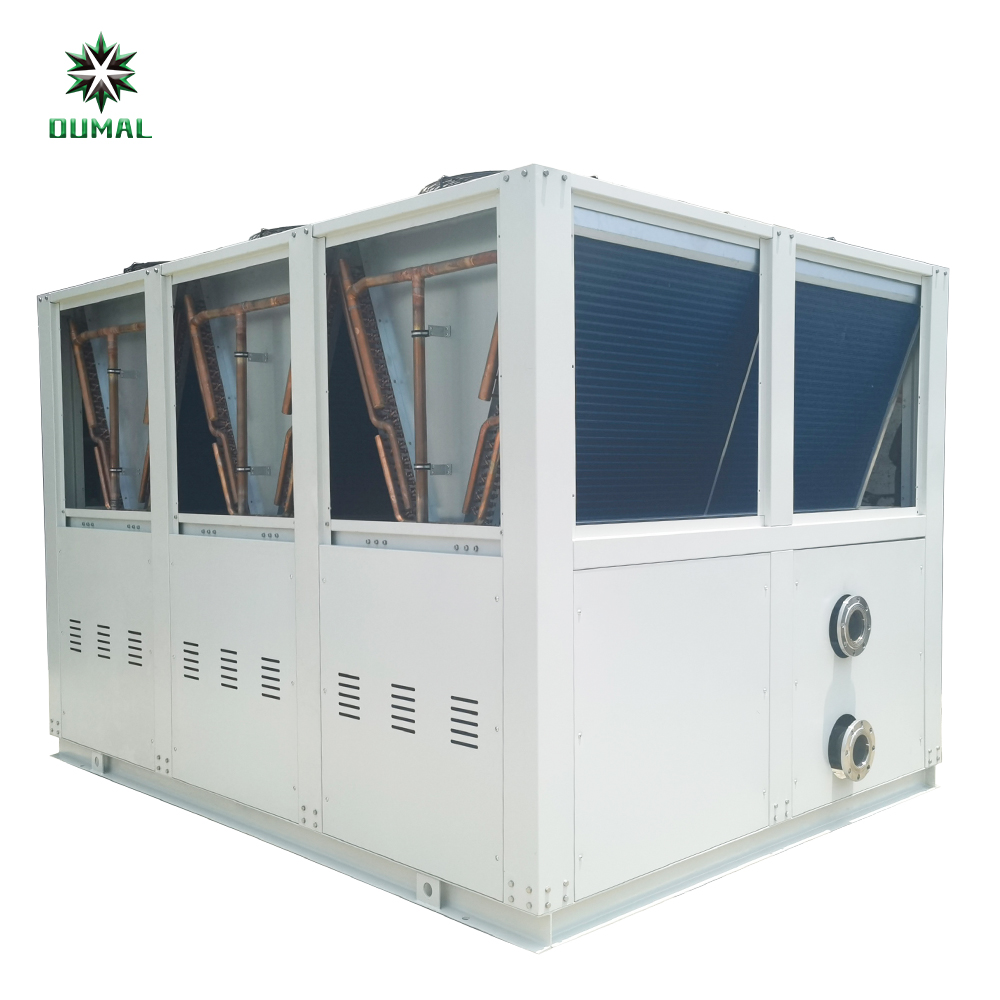
60RT 200KW-230KW Air Cooled screw chiller

Space Requirements

Think about space before picking a chiller. Air-cooled chillers need more room. They use air to get rid of heat. You must leave open space around them. This helps air move easily. These chillers are often outside. Sometimes, they go on rooftops. Water-cooled chillers use less space inside. But you need extra room for cooling towers. You also need space for pipes.

Chiller Type

Space Requirements

Air-cooled chiller

Needs more space for airflow and larger condenser units.

Water-cooled chillers

More compact indoors but require space for cooling towers and pipes.

Tip: If you do not have much outdoor space, water-cooled chillers can fit inside your building.


Installation Complexity

Check how hard it is to set up each chiller. Air-cooled chillers are easier to install. You can put them outside. You do not need extra parts. Water-cooled chillers are harder to set up. You must add cooling towers. You need pumps and pipes too. This takes more time and work.

Feature

Air-Cooled Chillers

Water-Cooled Chillers

Installation

Simpler, often installed outdoors

More complex, needs cooling tower and extra piping

Some problems can happen:

  • Air-cooled chillers are big and heavy. Putting them on a roof can be hard.

  • Water-cooled chillers need more pipes and cooling towers. This costs more money and time.

If you want a fast and easy setup, pick an air-cooled chiller. If you want better efficiency and have more time, water-cooled chillers may be best.


Environmental and Noise Impact

Water Usage and Sustainability

When you pick a chiller, think about water use. Water-cooled chillers need cooling towers. These towers use a lot of water. Water is lost by evaporation, drift, and blowdown. If you raise the cycles of concentration, you can save water. This can lower water use by up to 20%. Air-cooled chillers do not use water for cooling. They use air instead, so water use is low.

  • Water-cooled chillers need lots of makeup water each year.

  • More cycles of concentration in towers help save water.

  • Air-cooled chillers do not need water for cooling.

Water-cooled chillers can affect the environment a lot. They use much water, which is a problem where water is rare. If you do not treat the water before letting it go, it can hurt plants and animals nearby. These chillers also use power, which can cause more greenhouse gases.


Noise Levels

Noise is important when you put in a chiller, especially in cities. Air-cooled chillers make noise from fans, pumps, and compressors. Water-cooled chillers are quieter. Most water-cooled chillers run at 55 to 75 decibels. A well-kept chiller in a medium building might be 60 decibels. This is as quiet as gentle rain.

  • Air-cooled chillers make noise from fans and moving parts.

  • Water-cooled chillers are quieter and good for quiet places.

Local rules often limit how loud chillers can be. The World Health Organization says loud noise can harm your health. If your chiller is too loud, you could break city rules. This can upset neighbors and make work less comfortable for workers.


Maintenance Needs for Air Cooled Screw Chiller and Water-Cooled Chiller

Routine Maintenance

You need to take care of your chiller often. Both air-cooled and water-cooled chillers need regular checks. You should look at refrigerant levels a lot. If you find leaks, fix them fast. Clean the evaporator coils every six months. This helps the chiller work well. Test the electrical parts and change any broken ones. Lubricate moving parts so they last longer. For water-cooled chillers, watch water flow and pressure. Check oil quality and levels to stop breakdowns.

Maintenance Task

Description

Check Refrigerant Levels

Look at refrigerant levels and add more if needed. Find leaks and fix them quickly.

Inspect and Clean Evaporator Coils

Clean coils every six months so the chiller works better.

Test Electrical Components

Check wires and replace any broken parts.

Lubricate Moving Parts

Make sure moving parts have enough oil. Add more if needed.

Monitor Water Flow and Pressure

Watch water flow and pressure during checks.

Analyze Oil Quality and Levels

Test oil for dirt and change it if needed.

Air-cooled chillers need more care. Water-cooled chillers need less checking, but you must treat water and clean cooling towers. How often you do maintenance depends on how much you use the chiller, its age, and where it is.


Long-Term Reliability

You want your chiller to last a long time. Air-cooled chillers work for 15 to 20 years. Water-cooled chillers last 20 to 30 years. Problems happen from dirt, clogs, electrical issues, or not doing maintenance. If you keep up with care, you can stop most problems. Water-cooled chillers need extra water treatment and tower cleaning. Air-cooled chillers need coil cleaning and electrical checks more often.

Chiller Type

Average Lifespan

Air-Cooled Chillers

15 to 20 years

Water-Cooled Chillers

20 to 30 years

  • Main reasons chillers break:

    • Dirt buildup

    • Clogs

    • Electrical problems

    • Skipping maintenance

Tip: Doing regular maintenance saves money and keeps your chiller working well.


Choosing the Right Chiller for Your Business

Typical Applications

You want to find the best chiller for your business. The right chiller depends on your building size. It also depends on how much cooling you need and where you are. Each chiller type works best in different places.

  • If your business is small or you do not have much space, an air cooled screw chiller is a good choice. You can use it in offices or small factories. It is also good if water is hard to get. Air-cooled chillers work well in places with mild weather.

  • If you run a big place like a hospital or mall, a water cooled chiller is better. Water-cooled chillers give more cooling power. They work well in hot weather and can cool large buildings.

  • Air-cooled chillers are easy to put in. You can place them outside or on the roof. They do not need extra things like cooling towers.

  • Water-cooled chillers need more room inside. You need space for cooling towers and pumps. These chillers are quieter and save more energy. But you must plan for water use.

Here is a table to help you pick the right chiller:

Decision Factor

Air-Cooled Chillers

Water-Cooled Chillers

Cooling Capacity

Good for small and medium cooling needs

Best for big cooling needs and large buildings

Space Requirements

Small, fits tight spaces

Needs room for cooling towers and pumps

Initial Investment

Costs less at first, fewer parts

Costs more, needs extra equipment

Energy Efficiency

Not as good in hot weather, costs more to run

More efficient, works well in most weather

Environmental Impact

Uses more energy, bigger carbon footprint

Uses more water, smaller carbon footprint

Noise Level

Louder because of fans

Quieter, most noise is outside

Tip: If you want something simple and easy to set up, pick an air cooled chiller. If you need strong cooling for a big building, a water cooled chiller is better.


Quick Decision Checklist

Use this checklist to help you choose the best chiller. Answer each question to see which chiller fits your needs.

Factor

Description

Cooling Capacity

Do you need cooling for a small or big area?

Energy Efficiency

Do you want to save money on energy bills?

Special Features

Does your business need smart controls or special options?

Smart Controls

Will real-time monitoring help your team?

Future Growth Consideration

Do you plan to grow and need a system that can expand?

  • If you picked "small area" and "easy setup," an air-cooled chiller is best for you.

  • If you need lots of cooling, want to save energy, and plan to grow, a water-cooled chiller is better.

Note: Always think about your local weather, water supply, and future plans before you choose.

Now you can match your needs with what each chiller offers. This helps you pick the best chiller and avoid spending too much. The right chiller keeps your business working well and saves money over time.

You can look at the table to see the main differences. Air-cooled chillers use air to cool things. They fit in smaller spaces. Water-cooled chillers use water for cooling. They work better in big buildings. Use the checklist to find what you need. For the best choice, ask an HVAC expert before you pick a chiller.

Feature

Air-Cooled Chillers

Water-Cooled Chillers

Cooling Mechanism

Uses air

Uses water

Lifespan

15 – 20 years

20 – 30 years

Efficiency

Depends on air temperature

More efficient


阅读全文......

Why Choose a Screw Water Chiller for Industrial Cooling

Why Choose a Screw Water Chiller for Industrial Cooling

You want reliable cooling for your facility. A screw water chiller delivers powerful performance where you need it most. Industrial operations face challenges like high water usage, complex setups, and costly maintenance. The table below shows how this solution tackles these issues and keeps your business running efficiently.


Cooling Challenge

Solution Provided by Screw Water Chiller

Complexity of setup

Simple installation, no need for cooling towers

High water usage

Conserves water resources

Maintenance difficulties

Minimal maintenance required

Cooling large areas

Cools bigger spaces easily

Energy efficiency

Improves energy use and supports green goals


What Is a Screw Water Chiller?

You want a cooling system that delivers consistent results and keeps your operations running smoothly. A screw water chiller stands out as a powerful solution for industrial cooling. This system uses a screw compressor to move refrigerant through a closed loop, ensuring your facility stays at the right temperature for peak performance.


How Screw Compressors Work

A screw compressor uses two interlocking rotors to compress refrigerant vapor. This process starts when the compressor vaporizes the coolant at low gravity and temperature. The coolant then becomes a high-pressure gas. As this gas moves into the cooling chamber, it transfers heat to the chilled water. The thermostatic widening valve controls the flow of vacuum fluid into the evaporator, where the water cools to your desired temperature. The cooled liquid circulates back through the system, keeping your process stable and efficient.


Typical Industrial Uses

You can rely on a screw water chiller in many industries that demand reliable cooling. These systems excel in small- to medium-scale applications. Common uses include:

  • Plastics extrusion cooling

  • Injection mold cooling

  • Plating and anodizing cooling

  • Food process cooling

  • Pharmaceutical and chemical production

  • Commercial printing

  • Metal finishing

  • Composite manufacturing

  • Laser cutting

  • Machine tooling and die-cutting

  • Semiconductor manufacturing

If your business needs precise temperature control and dependable operation, a screw water chiller gives you the flexibility and reliability you expect.


Benefits of Screw Water Chillers

Industrial Water Chiller

Energy Efficiency

You want to cut costs and boost your bottom line. A screw water chiller helps you achieve this by delivering outstanding energy efficiency, especially under varying load conditions. The system uses advanced sequencing, load, and parameter optimization strategies to maximize savings. For example, frequency conversion control of the water pump plays a significant role in reducing energy consumption.


Optimization Strategy

Description

Sequencing Optimization

Introduces a threshold function considering wet-bulb temperature and cooling load.

Load Optimization

Activates smaller chillers under specific conditions to improve efficiency.

Parameter Optimization

Prioritizes adjustments before sequencing for better energy savings.

Over one summer, you can save up to 650,463 kWh, with sequencing contributing 5.64% to total savings. You also benefit from a novel efficiency model that helps you identify performance losses due to aging or improper operation. By monitoring these factors, you maintain high energy efficiency and keep your cooling performance at its best.


Quiet and Reliable Operation

You need a cooling solution that works smoothly and quietly. Screw water chillers offer a broad cooling capacity range from 80 to 2,000 RT, making them ideal for large operations. You get excellent load adaptability, from 10% to 100%, so your system responds to changing demands without missing a beat.

  • Screw chillers operate with fewer moving parts, which means less noise and fewer breakdowns.

  • Maintenance costs are 15–20% lower compared to centrifugal models.

  • You enjoy reliable operation with less downtime, keeping your facility productive.

The OMC-75WSH model stands out with its semi-hermetic screw compressor, which ensures quiet and stable operation. You can trust this unit to deliver consistent cooling performance in demanding environments.


Low Maintenance

You want to spend less time and money on upkeep. Screw water chillers make this possible with their simple design and robust components. The compressor has fewer moving parts, which means fewer things can go wrong. High-efficiency heat exchangers and advanced control systems further reduce wear and tear.

Maintenance Aspect

Cost Range (per year)

Compressor Check

$200 - $500

Cleaning Condenser & Evaporator

$300 - $800

Pump Maintenance

$150 - $400

Water Treatment Chemicals

$500 - $1500

Replacement Parts

$1000 - $3000

Service Contract

$3000 - $6000

You benefit from longer intervals between maintenance checks and lower annual costs. The OMC-75WSH features a Siemens PLC control system with self-diagnosis, making it easy to monitor and address issues before they become costly problems.


Safety and Flexibility

You need a cooling system that keeps your facility safe and adapts to your needs. Modern screw water chillers come equipped with multiple safety mechanisms to prevent operational hazards.

Safety Feature

Description

Automatic Shutdown Systems

Detect irregularities and shut down the chiller to prevent damage and ensure safety.

Pressure Relief Valves

Release excess pressure to prevent equipment rupture and maintain safe operation.

Temperature Monitoring Systems

Continuous checks allow for real-time adjustments and alerts if temperatures exceed safe levels.

The OMC-75WSH model includes protection against high and low pressure, compressor overheating, and flow issues. You get peace of mind knowing your equipment and staff are protected.

Flexibility is another key advantage. You can configure your screw water chiller to use different refrigerants, such as R134a, R407c, or R404a, depending on your operational and environmental needs. The system integrates easily with other cooling and air conditioning setups, making it versatile for a wide range of industrial applications. Customization options let you tailor the unit to your specific requirements, whether you work in plastics, pharmaceuticals, food processing, or metal finishing.


Screw Water Chiller vs. Other Chillers

Water Cooled Screw Chiller

Centrifugal Chillers Comparison

You want a cooling system that matches your facility’s demands. Centrifugal chillers use dynamic compression to convert kinetic energy into static energy. These machines deliver high efficiency at full load and operate with minimal maintenance. You get a long operational life and reliable performance in environments with constant, high-speed airflow. Centrifugal chillers work best in large commercial buildings and industrial plants where cooling loads remain steady.

Chiller Type

Energy Efficiency

Reliability

Screw Chillers

Best in part-load conditions

Reliable for variable loads

Centrifugal Chillers

Best in full-load conditions

Reliable for constant high-speed airflow

If your cooling needs fluctuate, a screw water chiller gives you better energy savings and adaptability. Centrifugal chillers excel when you need maximum output all the time.


Reciprocating Chillers Comparison

You may consider reciprocating chillers for their lower installation costs. These units use pistons to compress refrigerant, but they rely on older technology. You face more frequent maintenance and higher operational costs over time. Screw water chillers feature a rugged design, so you spend less on upkeep and enjoy lower operational costs.

Chiller Type

Operational Cost

Maintenance Requirements

Screw Chillers

Generally lower

Less frequent maintenance due to rugged design

Reciprocating Chillers

Lower installation

More frequent maintenance due to older technology

Choose a screw water chiller if you want a system that keeps maintenance simple and costs low.


When to Choose a Screw Water Chiller

You need flexibility and reliability in your cooling solution. Screw water chillers perform best when your facility experiences variable loads or part-load conditions. You benefit from energy efficiency, quiet operation, and easy integration with other systems. If your business requires adaptable cooling for plastics, pharmaceuticals, food processing, or metal finishing, this technology supports your growth.


Choosing a Screw Water Chiller

100 tr Packaged water cooled screw chiller

Key Features to Consider

You want a screw water chiller that delivers reliable cooling and maximizes your investment. Focus on features that drive performance and savings on energy costs. Look for high energy efficiency, proper capacity, and easy maintenance. The right unit helps you reduce energy consumption costs and keeps your operations running smoothly.

Feature

Description

Energy Efficiency

Reduces energy consumption and ensures reliable cooling, especially in high-demand settings.

Capacity and Sizing

Matches the chiller to your cooling needs to avoid inefficiencies and system failures.

Maintenance Requirements

Ensures long-term performance and minimizes downtime.

Advanced control systems boost operational efficiency and safety. You benefit from monitoring devices that track water flow, parameter verification to prevent abnormal operations, and post-startup inspections that protect your compressor. High and low pressure protection and electrical self-control systems add extra layers of safety.


Manufacturer Reputation

Choose a manufacturer with a strong reputation for quality and innovation. You want a solution that adapts to future needs and meets all regulatory standards. Look for smart controls and eco-friendly refrigerants that help you reduce energy consumption. Consider long-term ROI, including projected savings on energy costs and maintenance.

Criteria

Description

Scalability

Adapts to future capacity needs.

Regulatory Compliance

Meets current and upcoming standards.

Innovation

Offers smart controls and eco-friendly refrigerants.

Long-term ROI

Delivers energy savings and low maintenance costs.

Check for certifications like UL, CE, CSA, ETL, RoHS, REACH, ISO 9001, and ISO 14001. These show the manufacturer’s commitment to safety and quality.


Sizing and Customization

Get the right size by calculating your total cooling load and peak demand. Use the formula: BTU/hr = Gallons per hr x 8.33 x ΔT°F. Divide BTU/hr by 12,000 to find the cooling capacity in tons, then multiply by 1.2 for safety. Always round up to ensure your chiller meets your needs.

Customization matters. You can adjust the temperature range, control system, and component materials. Choose noise reduction features and tailor the design to your environment. The OMC-75WSH stands out with a temperature range of 5ºC to 35ºC, a semi-hermetic screw compressor, and multiple safety features like high and low pressure protection and compressor overheating protection. You get a unit that fits your requirements and supports your business growth.


阅读全文......

How to size a chiller - chiller cooling capacity caculation

The calculation method of chiller cooling capacity and the calculation summary of chiller selection


(1) How to choose the most suitable industrial chiller and screw chiller? In fact, there is a simple selection formula:

Cooling capacity = chilled water flow * 4.187 * temperature difference * coefficient

1. The flow rate of chilled water refers to the flow rate of chilled water required when the machine is working, and the unit needs to be converted into liters/second;

2. The temperature difference refers to the temperature difference between the water in and out of the machine;

3. 4.187 is quantitative (specific heat capacity of water);

4. When choosing an air-cooled chiller, multiply the coefficient by 1.3, and when choosing a water-cooled chiller, multiply it by 1.1;

5. Select the corresponding machine model according to the calculated cooling capacity.

It is generally customary to use HP to calculate how much the chiller needs to be equipped, but the most important thing is to know the rated cooling capacity. Generally, the air-cooled cooling capacity is 9.07KW and the 3HP chiller is selected, and so on. Therefore, the most important thing in the selection of industrial chillers is to obtain the rated cooling capacity.

(2) The calculation method of the cooling capacity of the chiller

How to calculate the cooling capacity of the chiller

1. Volume (liter) X number of temperature rise / heating time (minute) X 60 / 0.86 (coefficient) = (W)

2. Volume (tons or cubic meters) X number of temperature rise / heating time / 0.86 (coefficient) = (KW)

(3) Selection method of chiller

Energy conservation law Q=W in-W out

Q: Heat load (KW) W in: Input power (KW) example: 8KW, W out: Output power (KW) example: 3W

Example: Q=W in-W out=8-3=5 (KW)

Time heating method Q=Cp.r.V.ΔT/H

Q: Heat load (KW) Cp: Specific heat at constant pressure (KJ/kg.℃)……4.1868 KJ/kg. ℃,

r: Specific weight (Kg/m3)………1000 Kg/m3 V: Total water volume (m3) Example: 0.5m3

ΔT: water temperature difference (℃)…… ΔT= T2-T1 example: 5℃ H: time (h) example 1h

Example: Q=Cp.r.V.ΔT/H=4.1868*1000*0.5*5/3600=2.908 (KW)

Temperature difference flow method Q=Cp.r.Vs.ΔT

Q: Heat load (KW) Cp: Cp: Specific heat at constant pressure (KJ/kg.℃)……4.1868 KJ/kg. ℃,

r: Specific weight (Kg/m3)…….1000 Kg/m3 Vs: Water flow rate (m3/h) Example: 1.5m3/h

ΔT: water temperature difference (℃)…… ΔT= T2 (outlet water temperature)-T1 (inlet water temperature) Example: 10°C

Example: Q=Cp.r.Vs.ΔT=4.1868 * 1000 * 1.5* 10/3600 = 17.445 (kw)

Common plastic method: Q=W* C*ΔT * S

Q=the required frozen water energy kcal/h W=the weight of plastic raw materials KG/H Example: W=31.3KG/H

C=Specific heat of plastic raw materials Kcal/KG ℃ Example: Polyethylene PE C=0.55 Kcal/KG℃

ΔT= is the temperature difference between the melting temperature and the product film, ℃ generally (200℃)

S = safety factor (take 1.35-2.0) Generally take 2.0

Example: Q= W* C*ΔT * S=31.3 * 0.55 * 200 * 2.0 = 6886 (kcal/h)


When you need a chiller, Here is the Necessary info to quote.

1.What is your cooling capacity?_____    Kcal/hr  or   _____KW or _____RT?
2. What's your power supply? For example: 380V-50Hz-3N (N=Phase )
3.What refrigerant type do you require? R22 or R134a or R407c?
4. What's your ambient temperature?

And what is your chiller inlet and outlet water temperature?
5. Which industry do you use the chiller in?


阅读全文......