A complete plastic extrusion production line relies on four categories of auxiliary equipment: feeding and material handling, cooling and sizing, haul-off and cutting, and control and quality monitoring. The main extruder melts and pushes material, yet it cannot produce saleable product alone. A plastic extrusion machine depends on these supporting systems to run efficiently, maintain dimensional accuracy, and deliver reliable output shift after shift. Each category performs a distinct job along the plastic extrusion line, and weakness in any one of them can limit the performance of the entire process. Together, these systems help turn raw resin into finished pipe, profile, sheet, or flooring with consistent quality.
Key Takeaways
-
Feeding equipment delivers dry, accurately dosed resin to the extruder for consistent quality.
-
Cooling and sizing equipment help lock in the shape and dimensions of the extruded product.
-
Haul-off and cutting units control speed, length, and handling for steady output.
-
Control and monitoring systems coordinate production stages and help identify defects early.
-
Match auxiliary equipment to your material and product requirements for the best results.
Feeding Equipment for the Plastic Extrusion Machine
Loaders, Dryers, and Feeders
Every plastic extrusion machine starts with reliable material delivery. A vacuum loader pulls pellets, regrind, or powder from a storage bin to the machine hopper through a closed hose. Programmable loading and discharge cycles help maintain a consistent material supply. This setup reduces manual handling, limits spillage, and helps protect moisture-sensitive resins from ambient humidity and dust. Hopper dryers remove moisture before resin enters the screw, while suitable hopper agitation devices help prevent bridging when handling materials with low bulk density.
Dosing feeders then regulate material intake. A gravity feeder allows material to flow into the screw, while a crammer feeder helps maintain a more consistent feed when processing materials with different bulk densities. Gravimetric feeders provide more precise control: load cells continuously measure material weight, and the controller adjusts the feeding rate to maintain the target proportion. This accuracy helps keep additive percentages consistent throughout production. Crushers, shredders, and mixers can also form part of material preparation, allowing a plastic extrusion production line to reuse suitable production scrap under controlled conditions.
Gear Pumps and Material Preparation
A gear pump can be installed between the extruder and the die when an application requires more stable melt delivery. Its positive-displacement gears deliver a controlled melt volume with each revolution, so output can be adjusted through pump speed. This metering action helps reduce pressure fluctuations from the screw section and maintain more consistent pressure at the die inlet. Thin sheet and profile applications that require close thickness tolerances may benefit from this additional level of melt control.
Gear pumps may also be useful when processing certain recycled or variable feedstocks, provided the material is properly prepared and the pump is suitable for the melt condition. They are not essential for every plastic extrusion machine. The decision depends on material characteristics, output requirements, and product tolerances. For flooring manufacturers, the feeding and material preparation stages should also be considered alongside the extruder and downstream equipment. SKY WIN's SPC/PVC flooring sheet extrusion line integrates extrusion with downstream processing equipment to support continuous flooring sheet production.
Downstream Equipment in Plastic Extrusion: Cooling and Sizing
Vacuum Tanks and Cooling Troughs
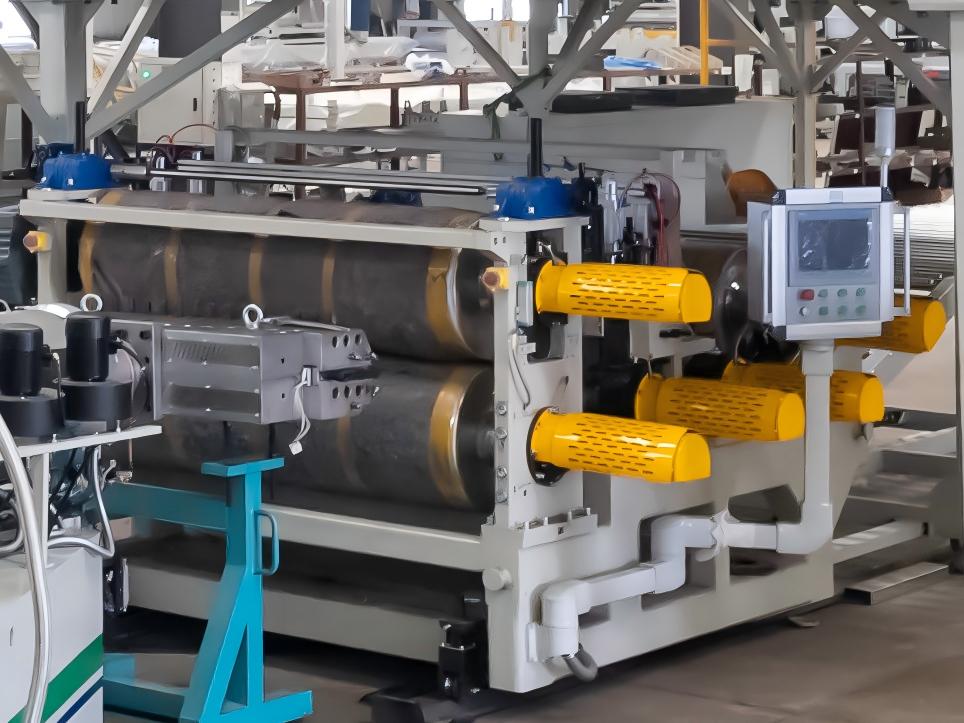
The downstream section begins where the melt leaves the die. A vacuum calibration tank is typically a horizontal water-filled unit used to cool and size the extruded product. A vacuum pump removes air from the calibration chamber, creating suction that helps press the hot extrudate against the sizing tool. Three elements work together: tooling that sets the exterior dimensions, differential air pressure that helps maintain the product shape, and a cooling medium that removes heat. The tank structure must be designed to withstand the operating vacuum. Further cooling by immersion or spray then helps stabilize the finished dimensions.
This stage is particularly important for thin-walled or intricate profiles. Controlled suction during cooling helps prevent the emerging profile from distorting. Air racks and additional cooling troughs extend the cooling process further down the line, allowing the product to stiffen gradually instead of being cooled too abruptly. The required arrangement depends on the material, product cross-section, line speed, and cooling capacity.
Chillers and Calibration Devices
Stable water temperature underpins the whole cooling system. Industrial chillers circulate temperature-controlled water through the die, vacuum calibration tank, and cooling bath. The required supply and return temperatures depend on the resin, product dimensions, production speed, and equipment design. A properly sized cooling system helps prevent deformation, improve surface quality, and maintain stable production. Unstable cooling can contribute to uneven wall thickness, surface roughness, or dimensional changes, so cooling capacity should be matched to the production target.
Continuous cooling of extruded sheets, films, or profiles requires stable water temperature across the production line.
Calibration and sizing hardware must also match the product. Brass and stainless steel calibrators are commonly used for different pipe sizes and production requirements. Disc calibrators, two-part block calibrators, and other specialized designs serve applications with different diameters, wall thicknesses, and cross-sections. Medical micro-tubing, for example, may require more specialized sizing solutions than standard industrial pipe. Each plastic extrusion machine must be paired with a suitable calibration set and cooling arrangement. Vacuum calibration and sizing decisions belong together because the cooling system and tooling share one goal: maintaining dimensional accuracy in pipe, profile, and sheet production.
Haul-Off and Cutting on the Plastic Extrusion Line
Haul-Off and Puller Units
The haul-off machine sits in the downstream section and sets the pace for the equipment behind it. A caterpillar haul-off grips pipe, profile, or sheet between moving belts and pulls it at a controlled rate. A suitable pulling length and contact area help maintain stable traction. Advanced traction systems are designed to minimize slippage and keep speed and tension consistent during continuous operation.
Speed control directly affects product dimensions. A pulling speed that runs too high can stretch a still-warm profile and alter its width or thickness. A speed that runs too low may allow material to accumulate between the extruder and the haul-off, causing the product geometry to drift. Matching pull speed to extrusion output helps keep width, thickness, and profile shape consistent. Grip pressure matters too: excessive pressure may mark soft material, while insufficient pressure can cause slippage. Some pipe production lines also use tilting or rotating handling units to support more even cooling and downstream handling.
Insufficient clamping force or unstable haul-off speed can change the diameter and wall thickness of extruded pipes. Caterpillar slippage may also result in production waste.
Saws, Cutters, and Winders
The final downstream equipment in plastic extrusion determines product length and prepares the output for handling or packaging. A traveling saw moves with the production line and cuts rigid pipe and thick profiles with a circular blade. A dust collection system can remove sawdust generated during cutting. A guillotine cutter is suitable for certain soft or flexible extrusions, while other cutting methods are selected according to product hardness, dimensions, and required edge quality. Servo-driven cutting systems can support continuous production where accurate cutting length and synchronization are important.
Sheet and film lines may finish with a coiler or winder. The flattened web wraps around a paper core, and tension control determines roll quality. Excessive tension can stretch or tear the film, while insufficient tension may produce loose or uneven rolls. Automatic tension control helps maintain stable winding conditions, so rolls remain compact and uniform. Every plastic extrusion production line should match its haul-off and cutting configuration to the product being manufactured. Each plastic extrusion machine also depends on proper synchronization between extrusion speed, pulling speed, and cutting operation.
Control and Quality on the Plastic Extrusion Line
Line Control and HMI Systems
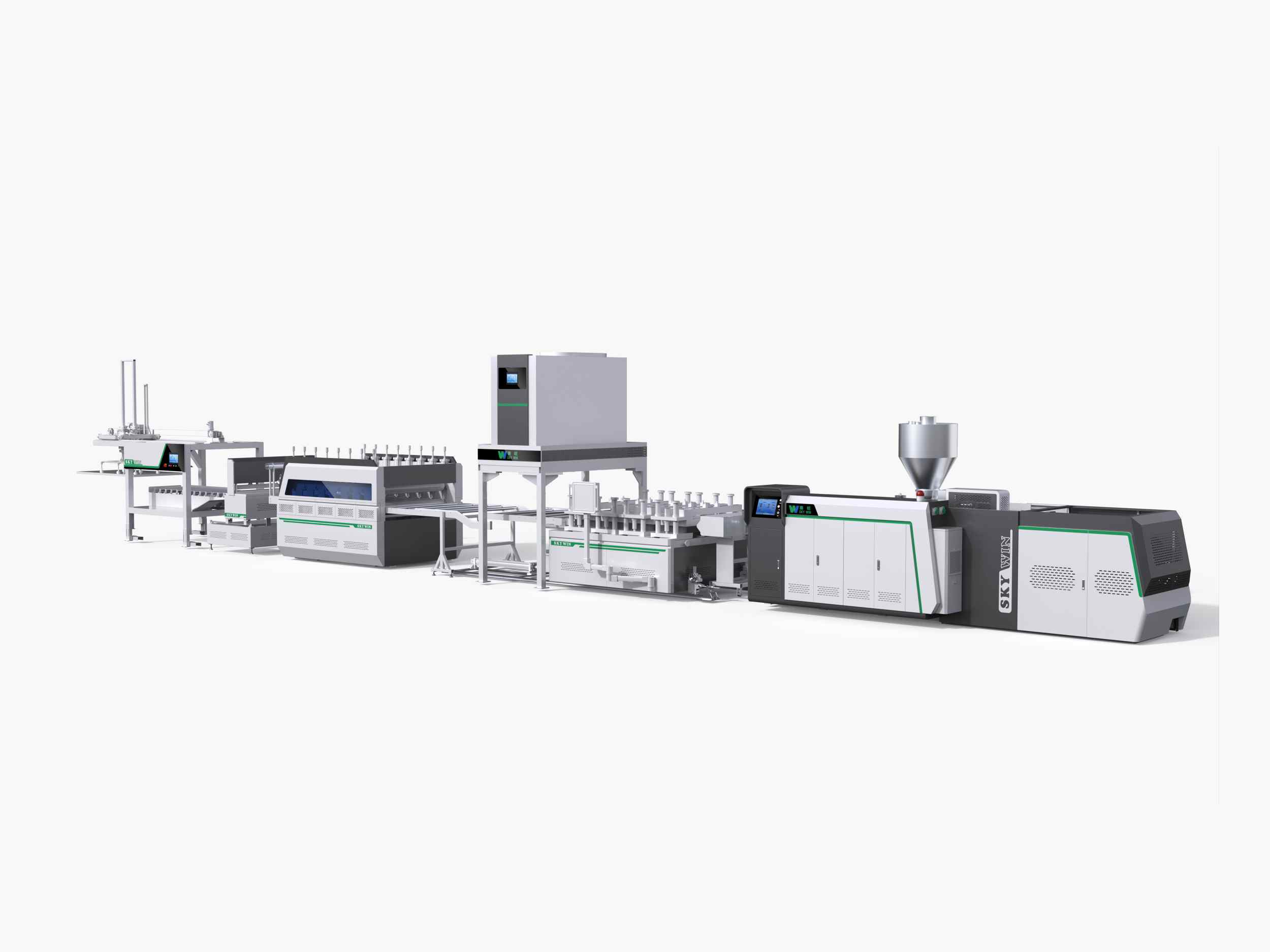
An extrusion line control system coordinates the main extruder and auxiliary equipment in one production process. Sensors and digital controls monitor temperature, pressure, screw speed, and material flow, giving operators continuous feedback. When a parameter moves outside its target range, operators can make adjustments before product quality is affected. Automated systems can coordinate feeding, temperature regulation, cutting, and other production functions, improving process consistency and reducing manual intervention during long production runs. Data collection also makes it easier to identify process deviations and maintain production records.
A well-designed electrical control panel simplifies operation and maintenance. Clear wiring labels, organized cable routing, and properly identified electrical components help technicians troubleshoot faults more efficiently. The HMI provides a central interface for monitoring the complete extrusion line, from the plastic extrusion machine through each downstream equipment unit. Operators can monitor relevant production parameters and coordinate haul-off speed, cooling conditions, and cutter timing from the control system. This integration helps the plastic extrusion line maintain consistent operating settings.
Inline Measurement and Inspection
Inline inspection devices help identify defects while the product is still moving through the production line. Measuring tools can monitor thickness, diameter, weight, and surface quality, allowing operators to correct process drift before excessive scrap accumulates. The inspection method should match the product. For example, a pipe line may prioritize diameter and wall thickness, while a sheet line may focus on thickness variation, width, flatness, and surface appearance.
Other inspection methods provide additional information. Computer vision systems can identify scratches, cracks, and discoloration in real time. Thermography can help reveal uneven cooling or temperature differences, while ultrasonic testing can be used for certain thickness measurement and internal inspection applications. When inspection data is connected to the extrusion line control system, operators can use the results to review haul-off speed, downstream conditions, and plastic extrusion machine settings. SKY WIN focuses on extrusion equipment for flooring and related plastic products, supported by its engineering and R&D team. For manufacturers evaluating a complete line, the WPC/PVC inside wall panel extrusion line is one example of an integrated system that combines extrusion, calibration, cooling, haul-off, and cutting. Matching inspection methods to the product and the downstream equipment helps reduce scrap and maintain consistent output.
How to Match Auxiliary Equipment to Your Production Needs
The right auxiliary equipment depends on the material, product dimensions, required output, and production process. A flooring sheet line, for example, needs suitable forming, cooling, trimming, haul-off, and cutting equipment. A profile line requires calibration and cooling units that match the profile cross-section. A WPC production line may also need material preparation and feeding equipment designed for its specific compound.
For manufacturers producing decorative panels, the WPC one-step profile extrusion line provides another equipment configuration to consider. The suitable system should be selected according to the material formulation, product shape, target dimensions, and production capacity. Buyers should confirm which auxiliary units are included in the quotation and which items need to be supplied separately.
Before purchasing, review the complete equipment layout rather than evaluating the extruder alone. Check whether the feeding system can maintain a stable material supply, whether the cooling section can handle the required line speed, and whether the haul-off and cutting units can keep pace with the extruder. A coordinated configuration is more important than selecting individual machines with the highest specifications.
A practical equipment selection checklist:
- Confirm the material type, formulation, and moisture requirements.
- Define the finished product dimensions and tolerance range.
- Check feeding capacity and material dosing accuracy.
- Match cooling capacity and calibration tooling to the required output.
- Confirm haul-off traction, speed control, and cutting accuracy.
- Review the PLC, HMI, safety functions, and monitoring requirements.
- Clarify installation, commissioning, operator training, and spare parts support.
Four auxiliary equipment categories keep a plastic extrusion production line reliable. Feeding systems deliver dry, accurately dosed resin. Cooling and sizing equipment help maintain product shape and dimensions. Haul-off and cutting units control speed, length, and handling. Control and monitoring systems coordinate production stages and help identify defects early.
Matching equipment to the material, product type, and output target matters more than buying the most expensive option. Moisture-sensitive resins need proper drying, while thick or heavy profiles may require greater pulling force and suitable calibration support. Buyers should evaluate technical compatibility, regulatory requirements, operating costs, and maintenance needs together. A well-matched plastic extrusion machine and its supporting equipment can deliver more consistent quality than premium hardware selected without considering the actual application.
FAQ
What counts as plastic extrusion auxiliary equipment?
Plastic extrusion auxiliary equipment covers the supporting systems used around the main extruder. This includes vacuum loaders, dryers, and feeders on the input side, as well as cooling tanks, chillers, calibration units, haul-offs, cutters, and control panels downstream. Each unit performs a specific function, and together they help a plastic extrusion production line turn raw material into finished products.
Does a plastic extrusion machine need a gear pump?
Not every line needs one. A gear pump can be useful when a product requires close thickness tolerances or more stable melt delivery. It helps reduce pressure fluctuations and maintain consistent flow to the die. Many standard profile and sheet applications can operate without a separate gear pump, so the decision should follow the product specification and process requirements.
How does a buyer match cooling equipment to output?
Start with the production speed, material, and product dimensions. Faster lines and thicker products generally require more cooling capacity, so the chiller and cooling section must be sized accordingly. Water temperature should remain stable under the actual production load. A supplier can help confirm the configuration based on the product specifications and target output.
Which factors matter most when specifying a plastic extrusion production line?
Technical compatibility comes first. Material type, product dimensions, required output, and process conditions determine the equipment configuration. Buyers should also review applicable regulatory requirements, energy consumption, maintenance costs, and after-sales support. Evaluating these factors together helps ensure that the selected line meets actual production needs.