Production capacity on a PVC profile extrusion line emerges from six interacting elements: extruder hardware, die and cooling design, downstream equipment, material formulation, process settings, and operational discipline. Each element imposes its own ceiling on output. The line's true capacity therefore equals the limit of its weakest link, not the sum of its strong points.
A high-torque extruder cannot compensate for a short cooling tank. A well-balanced die cannot outrun a slow haul-off. This guide treats capacity as a system property. Readers can use it to audit an existing PVC profile production line or to evaluate equipment decisions before purchase. The same logic supports both goals: find the constraint, then relieve it.
Key Takeaways
-
Production capacity equals the weakest link in the line, not the sum of strong parts.
-
The extruder sets the upper limit, but die and cooling must match its output.
-
Downstream equipment like haul-off and cutting must keep pace with the extruder.
-
Material quality and process settings determine how much of the capacity you actually use.
-
Measure saleable output, not just extruder throughput, to find the real constraint.
Extruder Specs Set the Capacity Baseline
The extruder anchors every PVC profile extrusion line. Its hardware fixes the upper limit that die, cooling, and downstream equipment can only work within. Buyers who compare machines on price alone often overlook this point. The barrel, screw, and drive together decide how much melt the line can deliver and how steadily it delivers it.
Screw Diameter and L/D Ratio
Screw diameter ranks among the most important factors affecting extrusion output. A larger barrel holds more material per revolution, so each turn of the screw pushes a greater volume toward the die. Diameter alone does not tell the full story, however. The length-to-diameter ratio, or L/D, governs how long the polymer stays in the barrel, how much shear it meets, and how evenly it melts before reaching the die.
|
Aspect |
Effect of Increasing L/D |
Implication for PVC Profile Extrusion |
|---|---|---|
|
Specific output rate |
Rises modestly, then plateaus beyond ~30:1 |
Extra length does not proportionally raise throughput |
|
Output stability |
Longer L/D enables stable output at higher screw speeds with better melt homogeneity |
Reduces surging and die-face variation, improving dimensional consistency |
|
Residence time |
Scales directly with L/D at constant RPM (e.g., ~50% more for 36:1 vs 24:1) |
Excess residence time risks degradation, color shift, and reduced shelf life for heat-sensitive PVC |
|
Practical trade-off |
A shorter screw at higher RPM may match throughput but with more surging and hotter melt |
Stability, not peak throughput, is the main benefit of higher L/D |
Heat-sensitive PVC formulations sometimes call for short screws at L/D of 18:1 or below, which keeps residence time minimal and lowers degradation risk. Longer screws buy more heat-transfer time and mixing elements, which helps disperse pigments, fillers, and additives. The right balance depends on the compound and the profile.

Drive Power and Gearbox Torque
Drive power and gearbox torque cap the maximum screw speed the line can sustain under load. A motor that looks generous on paper still stalls if the gearbox cannot transmit torque through a stiff melt. Processing rigid PVC or WPC demands high torque. A weak gearbox will stall or surge, and output becomes inconsistent.
|
Model (screw Ø) |
Drive Power |
Screw RPM |
Max Output |
|---|---|---|---|
|
TSE-75 (Ø75mm) |
40 HP |
42 |
200–300 kg/hr |
|
TSE-90 (Ø90mm) |
75 HP |
42 |
300–500 kg/hr |
|
TSE-110 (Ø107mm) |
100 HP |
48 |
500–700 kg/hr |
|
TSE-130 (Ø132mm) |
125 HP |
48 |
950–1,200 kg/hr |
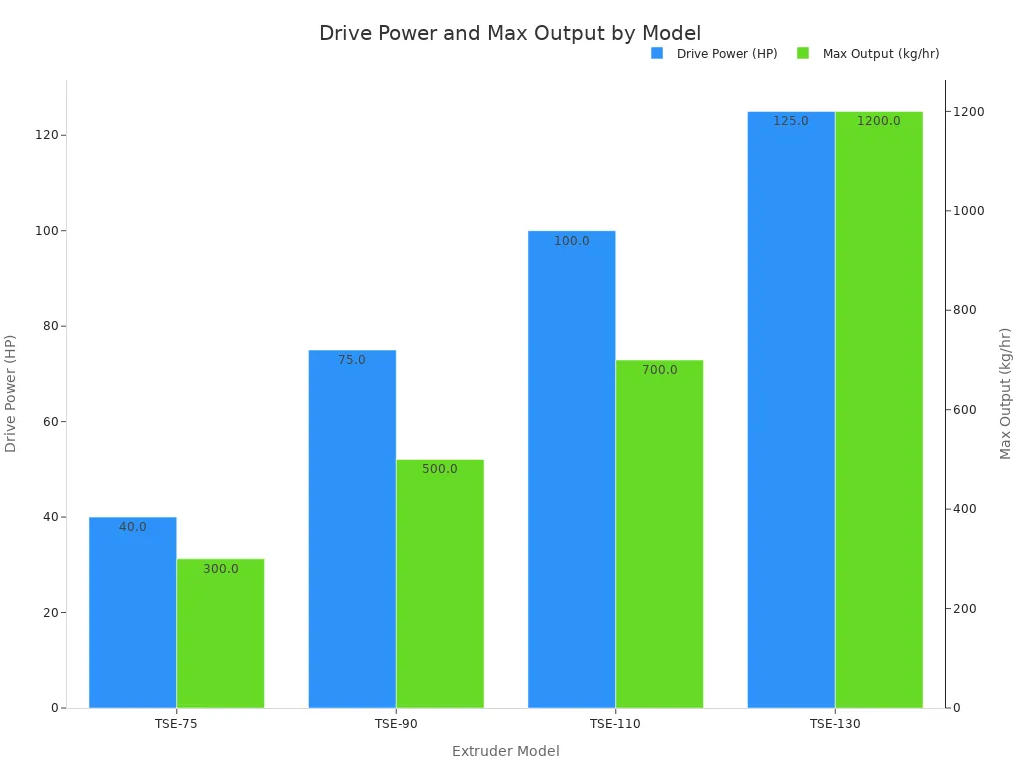
Processing WPC or rigid PVC requires high torque. If the gearbox is weak, the machine will stall or surge, leading to inconsistent output. Twin Screw utilizes high-torque gearboxes and custom-designed screws manufactured in-house. By controlling the screw geometry, we ensure stable melt pressure — critical for maintaining the tight tolerances required for door assemblies.
The extruder type matters here. Single-screw and twin-screw configurations each fit different profiles and output goals. Counter-rotating conical twin-screw extruders suit many rigid-pvc profiles, while parallel twin-screw extrusion can raise efficiency, quality, and versatility for higher throughput goals. Suppliers such as SKY WIN, founded in 2004 with 50+ patents and ISO 9001, CE, UL, and SABER certification, engineer these drives for precision and durability, serving 1,500+ clients in 43 countries.
Die and Cooling Shape Throughput on a PVC Profile Extrusion Line
Die design affects the versatility and output capability of the line. A well-made extrusion die distributes melt evenly across the profile cross-section. Poor flow balance creates dead spots and fast lanes. Fast lanes push material through thin walls too quickly, which forces operators to slow the whole line. Die size and internal flow balance therefore influence achievable speed directly. A balanced die lets the line run at its target throughput without constant adjustment.
Die Head Flow Balance
Flow balance starts with the internal geometry of the die head. The melt channel must deliver equal pressure and equal velocity to every point of the profile. An unbalanced die produces thick and thin sections, and operators compensate by reducing line speed. This trade-off lowers output and raises scrap. A balanced die supports higher capacity and line speed because the profile stays within tolerance at faster pull rates. Die makers test flow balance on each new profile, and they adjust channel depths until the melt spreads evenly. This step matters most for complex hollow profiles and for rigid PVC, which tolerates little variation in melt pressure.
Cooling Tank and Calibration Sizing
Cooling tank length and calibration sizing limit how fast the profile can be pulled without distortion. A short tank cannot remove heat fast enough, so the profile sags or warps as it leaves the calibrator. Calibration sleeves must match the profile size and shrink behavior of the compound. Undersized sleeves grip too tightly and raise pull resistance. Oversized sleeves allow dimensional drift. Both problems cap line speed below the extruder's real output. Supporting systems decide whether the line can run consistently at the required production rate. Vacuum levels, water temperature, and spray coverage all belong to this group. A PVC profile extrusion machine with a well-matched calibration and cooling section holds dimensions at high speed. Twin-screw extrusion paired with a properly sized tank gives steady throughput on a PVC profile production line. Operators should size the tank to the fastest speed the die and extruder can support, not to the average rate.

Downstream Equipment Must Keep Pace
The extruder and die may deliver melt at full rate, yet the finished profile only counts once it leaves the line in saleable form. Downstream equipment converts melt into product, and its limits cap effective production capacity. Haul-off speed, cutting accuracy, and stacking capacity each set a ceiling. A haul-off that pulls too slowly drags the whole line below its rated rate. A puller that runs fast but surges spoils wall thickness and forces operators to slow down again. Cutting accuracy matters just as much. A saw that lags behind the line speed creates length errors and jams, and every jam costs uptime. Stacking capacity closes the chain. If the stacker cannot keep up, finished profiles pile at the saw and the operator stops the line.
Haul-Off, Cutting, and Stacking
Haul-off units must hold constant tension across the full speed range. Belt or caterpillar pullers with servo control keep the profile moving at a steady rate, which protects dimensional stability and output consistency. Cutting units need to travel with the profile during the cut, and their cycle time must match the fastest rate the line can run. Stacking systems should accept parts at that same rate without manual intervention. Each of these three units deserves sizing against the peak rate of the PVC profile extrusion line, not its average.
Auxiliary Handling and Line Synchronization
Auxiliary handling covers the smaller systems around the main train: vacuum calibrators, water pumps, dust extraction, and take-away conveyors. Synchronization ties them together. When the haul-off, saw, and stacker share speed signals, the line runs as one machine. When each unit runs on its own setting, small mismatches accumulate into bottlenecks. A slow conveyor or a lagging saw cycle can idle a perfectly capable extruder. The principle holds across every extrusion setup: the line runs only as fast as its slowest supporting system. Auditing a PVC profile production line for output gains therefore starts at the downstream end, where hidden constraints often sit.
Material and Process Parameters in the PVC Profile Extrusion Process
Hardware sets the ceiling, yet the compound and the settings decide how much of that ceiling the line actually reaches. The material being processed affects extrusion capacity before any screw turns. A heavily filled compound flows differently from a lean one, and a trial formulation may run well on a small sample while behaving poorly at full rate. Formulators therefore test each recipe for flow, fusion, and thermal stability before the line commits to it. Filler percentage shifts the balance too. Higher filler loading lowers raw material cost, and it also raises melt viscosity and narrows the processing window. Saleable output depends on this trade-off, because a formulation that forces slower running can cost more than the filler saves.
PVC Compound and Dry Blend Quality
Dry blend quality determines how evenly the compound melts and how stable the process stays. Poor mixing leaves unmelted pockets and inconsistent grain structure, and operators respond by slowing the line to protect dimensions. Profile drawing and weight per meter then convert raw extruder throughput into saleable output. A heavy profile consumes more kilograms per meter, so the same screw rate yields fewer meters of finished product. Planners who compare machines on kilograms per hour alone miss this point. They should calculate saleable output in meters per hour or pieces per hour at the target weight per meter, then match that figure against production goals.
Temperature Profile and Screw Speed
Temperature profile and screw speed settings balance output against quality and stability. Running the barrel hotter lowers melt viscosity and raises achievable rate, and it also narrows the safety margin for heat-sensitive rigid PVC. Running cooler protects the compound and limits how fast the screw can turn. Screw speed follows the same logic. Higher RPM lifts output until melt quality, mixing, or die pressure becomes the constraint. The table below summarizes how each adjustment shifts the balance.
|
Adjustment |
Effect on Rate |
Effect on Stability |
|---|---|---|
|
Higher barrel temperatures |
Raises achievable speed |
Shrinks the degradation margin |
|
Lower barrel temperatures |
Limits screw speed |
Protects heat-sensitive compound |
|
Higher screw speed |
Lifts raw output |
Demands better mixing and melt control |
|
Lower screw speed |
Reduces raw output |
Improves melt homogeneity |
Operators should tune these settings against measured profile quality, not against the nameplate rate. A stable PVC extrusion process at moderate speed beats a fast run that produces scrap. Twin-screw extrusion gives operators more room to push screw speed because its mixing action handles compound variation well. Each PVC profile extrusion line deserves its own settings window, documented and repeated across shifts. That discipline turns a capable PVC profile extrusion machine into a predictable producer.
Operational Factors That Cap Real Capacity
Rated capacity describes a machine running without interruption. Real capacity describes a plant running with changeovers, maintenance, and human judgment. The gap between the two decides how much money the line actually earns.
Maintenance, Changeovers, and Uptime
Downtime erodes production capacity faster than most buyers expect. A standard line can spend four to six hours on each changeover. A quick-change system cuts that figure below two hours and recovers more than 200 hours of production time each year. Product changeovers also consume 30 to 60 minutes of scrap-generating time each, so two changeovers per day can generate one to two hours of waste. Preventable failures compound these losses. Seized bearings, degraded thermocouples, and worn screws all stop the line, and reactive repairs cost far more than preventive investment.
Saleable output = rated kg/h × operating hours × uptime × yield. A 500 kg/h line at 75% uptime and 94% yield produces less saleable material than its nameplate rating — realistic changeover and maintenance assumptions must be applied when estimating payback.
Scenario
Changeover Time
Annual Production Impact
Standard 65-line
4–6 hours per changeover
—
Quick-change system
Under 2 hours per changeover
200+ hours of production time recovered annually
Operator Skill and Process Control
Operator skill shapes stability and scrap rates on any PVC profile extrusion line. A fragile process depends on constant manual correction. Skilled hands compensate for melt pressure swings and correct diameter drift by feel. A stable process rests on controlled cause-and-effect relationships among melt temperature, pressure, die flow balance, cooling, and haul-off speed. Modern lines use synchronized sensors to hold that balance automatically. Precise control over temperatures, pressures, and line speed delivers consistent dimensions and surface finish, which lifts output consistency and cuts scrap. Automation such as gravimetric blenders and inline quality sensors lets one or a few operators oversee an entire extrusion line.
Planners should compare machines on saleable production, not raw extruder throughput. Match expected output in kilograms per hour or pieces per hour against production targets, and treat every hour of downtime as lost capacity. That habit keeps the PVC extrusion process honest and turns the pvc profile extrusion process into a predictable business.
Production capacity on a PVC profile extrusion line emerges from six interacting elements: extruder specs, die and cooling design, downstream capability, material formulation, process settings, and operations. No single upgrade lifts output on its own.
The line runs only as fast as its bottleneck allows. Identifying that limiting factor and upgrading it delivers the largest gain per dollar spent.
Readers should audit each factor against their own line and production goals. Compare saleable output, measured in kilograms or pieces per hour, rather than raw extruder throughput. That comparison reveals the true constraint and the next step toward higher output.
FAQ
Which single factor most often limits output on a PVC Profile Extrusion Line?
Cooling and downstream equipment limit output most often. A short tank or a slow haul-off forces operators to reduce screw speed. The extruder then runs below its rated rate. Auditing the cooling section and the puller first usually reveals the real constraint.
How does screw L/D ratio affect extrusion stability?
A longer screw raises residence time and improves melt homogeneity. Stable output at higher screw speeds becomes possible. Heat-sensitive compounds still need short screws near 18:1 to limit degradation risk. The right ratio depends on the formulation and the profile.
Can a buyer compare machines using nameplate throughput alone?
No. Nameplate figures describe raw extruder output under ideal conditions. Real capacity falls with changeovers, downtime, and scrap. A 500 kg/h line at 75% uptime and 94% yield delivers far less saleable material. Buyers should compare saleable kilograms or pieces per hour instead.
What role does dry blend quality play in a PVC Profile Production Line?
Dry blend quality decides how evenly the compound melts. Poor mixing leaves unmelted pockets and unstable grain structure. Operators then slow the line to protect dimensions. Consistent blending supports steady output on any PVC Profile Extrusion Machine.
How much production time can quick-change systems recover?
A standard line spends four to six hours on each changeover. A quick-change system cuts that figure below two hours. The difference recovers more than 200 hours of production time each year. Faster changeovers also reduce the scrap generated during each product switch.