A wpc flooring manufacturing line combines several machine groups: mixing, extrusion, calibration and cooling, haul-off, cutting, surface treatment, and quality control. Each stage follows a fixed order. The extrusion stage depends on a well-blended mix, and every later step depends on the profile leaving the die.
This complete equipment list defines the plant layout and power requirements. The sections below explain each machine's function. They also cover the factors behind equipment selection: production scale, budget, and product specifications. SKY WIN supplies wood-plastic composite extrusion systems built around these stages, and each WPC flooring extrusion line follows the same logical sequence from raw material to finished board.
Key Takeaways
-
A WPC flooring line uses seven machine groups in a fixed order: mixing, extrusion, calibration and cooling, haul-off, cutting, surface treatment, and quality control.
-
Each stage depends on the previous one, so a well-blended mix and a good extrusion die are critical for a quality board.
-
Buyers should choose equipment based on production scale, budget, and product specifications, not just the largest configuration.
-
Surface treatment can run inline for high-volume standard designs or offline for flexible, low-volume specialty designs.
-
Before buying, check supplier support: after-sales service, spare parts availability, on-site commissioning, and operator training.
Mixing and Preparation Equipment
WPC flooring manufacturing starts with three raw materials: PE granules, wood powder, and additives. Some designs add an optional PE top layer for surface appearance. A raw material drying system removes moisture before blending, and a raw material metering and mixing system controls how much of each component enters the line.
Crushers, Pulverizers, and Dryers
Crushers and pulverizers size wood powder and recycle production scrap. The RCM1300 crushing machine runs at 90 kW with 18 moving and 4 fixed alloy blades, and it delivers 2000–3000 kg/h without pre-cutting. The RMM800 mill uses 36 moving and 20 fixed blades, an 11 kW fan, and a strong wind cooling system that lowers internal temperature. It outputs 800–1200 kg/h at 20–40 mesh.
A turbo-type pulverizer offers finer control. Its adjustable rotary and fixed blades, plus a vibrating screen matched to the target mesh, produce 15–100 mesh powder at 100–900 kg/h. Oversize particles return for further grinding.
| Parameter | RCM1300 Crusher | RMM800 Pulverizer |
|---|---|---|
| Power | 90 kW | 90 kW |
| Capacity | 2000–3000 kg/h | 800–1200 kg/h (20–40 mesh) |
High-Speed Mixers and Feeding Systems
The high-speed mixer disperses PVC powder and additives through strong shear and friction heat. It reaches 100–140°C, and a paired low-speed cooling mixer prevents agglomeration. This hot-cold unit gives the extruder a stable dry blend.
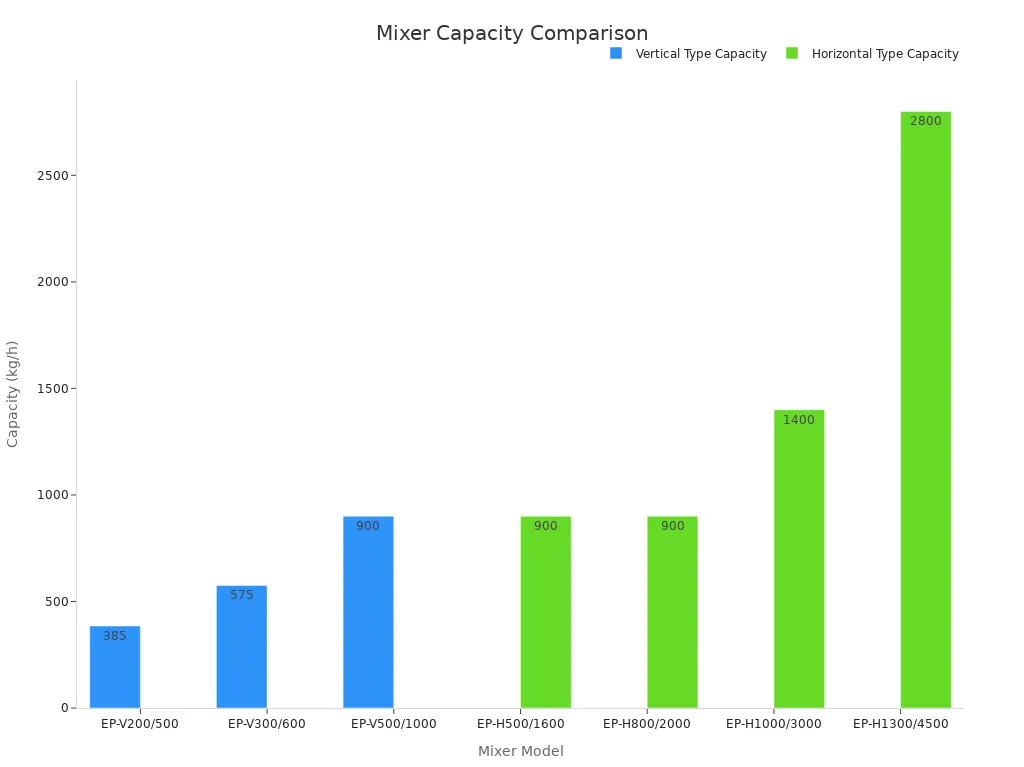
Vertical models such as the EP-V500/1000 reach 800–1000 kg/h. Horizontal models such as the EP-H1300/4500 reach 2600–3000 kg/h. Feeding systems then move the blend to the extruder, and batching accuracy directly affects board consistency. SKY WIN builds each WPC Flooring Extrusion Line around this preparation stage, so the extrusion that follows starts from a controlled mix.

Core Equipment in a WPC Decking Extrusion Line Setup
The extrusion system is the heart of any WPC decking extrusion line setup. In the PVC celuka foam process, the extruder fuses PVC powder, wood powder, and additives, then foams the melt into a board with a dense skin and a foamed core. SKY WIN Technology Co., Ltd. has manufactured SPC and WPC extrusion equipment since 2004. The company sources core components — motors, gearboxes, electrical systems, and control platforms — from top-tier global brands. It also offers turnkey installation, commissioning, and training. ISO 9001, CE, UL, and SABER certifications serve as useful selection reference points for buyers comparing suppliers.
Twin-Screw Extruders and Screw Configurations
The twin-screw extruder drives every WPC decking extrusion line. Two intermeshing screws convey material from the hopper to the die, and the geometry controls mixing quality. Conical twin-screw machines suit WPC compounds with 40–70% wood flour by weight. The large feed zone handles fluffy, low-density blends, and hard-faced flights resist wood-fiber abrasion. Low-speed, high-torque operation keeps shear heat moderate, and self-wiping flights prevent stagnation that would degrade heat-sensitive PVC.
| Parameter | Conical Twin Screw | Parallel Twin Screw |
|---|---|---|
| Typical L/D ratio | 6:1 to 9:1 (large-end basis) | 28:1 to 52:1 |
| Screw speed | 20–50 rpm | 100–600 rpm |
| Primary applications | PVC pipe, profiles, WPC | Compounding, masterbatch |
Screw speed, venting, and barrel temperature are the process parameters that most affect foam cell structure. Atmospheric and vacuum venting remove moisture released by the wood fiber, and low speed keeps the melt below 190°C to avoid cellulose degradation. A well-matched twin-screw extruder therefore supports uniform foaming with small, dense cells.
Dies and Calibration Tables
The extrusion die shapes the profile, and the vacuum calibration table sets thickness and surface flatness immediately downstream. In celuka foaming, an internal mandrel forces melt into a hollow annular flow path. The outer layer cools rapidly against the calibrator and forms a tough crust, while the core foams freely. A 100 mm thick mirror-surface calibrator handles extrusion and calibration molding.
| Max shape range (mm) | Forming table length (mm) | Vacuum pump power (kW) | Water pump power (kW) |
|---|---|---|---|
| 100 | 4000 | 1×3 | 1×2.2 |
| 200 | 5000 | 2×5.5 | 1×4 |
| 600 | 6000 | 3×5.5 | 1×4 |
The calibration table is built from 304 stainless steel for corrosion resistance and durability, using a stable vacuum system to hold profile dimensions and circulating cooling water for uniform cooling.
A vacuum calibration table for WPC decking holds the still-soft profile against sizing tools while chilled water solidifies it. Buyers specifying a complete WPC decking extrusion line should match die and calibrator tooling to each profile design. SKY WIN builds complete WPC decking extrusion lines, and each WPC Flooring Extrusion Line, WPC Flooring Production Line, and WPC Flooring Making Machine follows this same extrusion sequence.
Cooling, Hauling, and Cutting Equipment
Natural Cooling Systems and Haul-Off Machines
A hot profile leaves the die soft and deformable. The calibration table and the natural cooling system stabilize it before haul-off. Vacuum pressure between −0.02 and −0.06 MPa pulls the soft surface against a precision sleeve, locking width, height, and wall thickness. Water spray then begins removing heat. A 1–2 mm misalignment at this stage causes uneven wall thickness or drag marks.
Cooling method matters. Spray cooling removes heat gradually and limits internal thermal stress, which suits thick solid profiles. Immersion extracts heat faster, which suits thin hollow profiles. Too cold a bath shocks the surface and cracks it. Too warm a bath leaves the profile soft at the haul-off. The haul-off unit then grips the cooled board and pulls it at a steady rate. Caterpillar types spread the force evenly and avoid localized deformation. Speed must match extruder output. Too fast stretches and thins the profile; too slow builds material at the calibrator entrance.
Cutting Machines and Stacking
Cutting machines trim boards to length once the profile is stable. The cutter cycle must synchronize with haul-off speed, or board length drifts. Stacking and automatic handling systems then collect finished boards and prepare them for packing.
Downstream equipment parameters belong in the line specification. Power draw and floor space for the cutter and stacker vary with board size and output target. SKY WIN supplies these downstream units as part of a complete WPC Flooring Extrusion Line, and each WPC Flooring Production Line and WPC Flooring Making Machine is specified as one coordinated system. Buyers should confirm cutter and stacker ratings against the extruder and die they select.
Surface Treatment Equipment
Sanding, Embossing, and Napping Machines
Surface treatment turns a plain board into a finished floor. Sanding machines smooth the board face and remove die lines left by the calibrator. A sanding head presses an abrasive belt against the moving board, and the operator sets depth to cut only the surface skin. Embossing machines press a heated roller into the face to create wood grain, stone texture, or a matte finish. The pattern on the roller transfers directly to the board, so roller quality controls the final look. Napping machines use brushes to open the surface fibers and produce a soft, deep texture.
These machines work after the die has shaped the profile and the board has cooled. Each unit must track the line speed set by the extrusion haul-off. A mismatch between sanding depth and extrusion output shows up as uneven texture or visible die marks. SKY WIN builds surface treatment units to run with its WPC Flooring Extrusion Line, and each WPC Flooring Production Line pairs these units with the correct die and haul-off settings.
Online vs. Offline Treatment
Treatment can run inline or as a separate offline step. The choice is a fit question, not a quality ranking. Inline treatment places sanding and embossing directly after the die and cooling section. The board moves from extrusion to texture in one pass, which suits high-volume standard designs with a fixed pattern. Offline treatment moves finished boards to a separate station. This layout suits flexible or low-volume specialty designs, because the line can switch patterns without stopping the extrusion.
Buyers should match the layout to product design and output goals. A plant running one standard grain at high volume gains from inline flow. A plant offering many textures in small batches gains from offline flexibility. Either way, the die and the surface unit must share the same board dimensions. SKY WIN supplies both layouts and configures each WPC Flooring Making Machine around the buyer's pattern range.
Quality Control and Auxiliary Equipment
Inspection and Testing Equipment
Quality control starts with dimensional checks. Operators use a calibrated digital caliper, micrometer, steel rule, precision straightedge, feeler gauges, and an engineer's square against a flat reference surface. These tools verify the key tolerances for WPC boards.
| Parameter | Requirement |
|---|---|
| Length deviation | 0 to +10 mm (no negative tolerance) |
| Width deviation | ±1 mm; max-min difference ≤3 mm |
| Thickness deviation | ±0.5 mm (<25 mm); ±1.0 mm (≥25 mm) |
| Straight angle | ≤0.30 mm |
| Straightness | ≤1.0 mm |
| Density | ≥1.2 g/cm³ |
| Surface quality | Uniform color, flat surface, no scratch, no burr |
| Blister, bubble, crack, split | Not allowed |
Visual checks run under consistent lighting against an approved control sample. Inspectors record defects by plank, carton, and location. Intelligent online surface inspection adds optical cameras and image-processing software to scan every board for folds, pits, bubbles, and impurities. The equipment should scale with the line's output and target product grade. A plant running a high-output WPC Flooring Extrusion Line needs faster inspection than a small operation.
Dust Collection, Conveying, and Packaging
Auxiliary systems keep the line clean and the material flowing. Dust collectors capture sawing and profiling dust, and a covered cutting system improves workplace safety. Material feeding ranges from a simple screw loader to a dust-free vacuum loading system. Closed-loop conveying and silos for PVC, recycled material, oil, and CaCO3 reduce material loss.
Packaging systems include automatic packing machines and pallet wrapping machines. Selection should match production scale, budget, and technical requirements. Buyers should not default to the largest configuration. SKY WIN configures these auxiliary units around each customer's line, and the final requirements depend on output goals and product specifications.
A WPC flooring line runs through seven stages: mixing and preparation, extrusion, calibration and cooling, haul-off, cutting, surface treatment, and quality control. Each stage carries its own equipment, and each depends on the stage before it.
No universal configuration exists. Production scale, budget, product specifications, and technical requirements shape every choice, from mixer size to surface treatment layout. A WPC Flooring Extrusion Line from SKY WIN is configured around these factors rather than sold as a fixed package.
Before purchasing, buyers should evaluate suppliers on four points:
-
After-sales support and regional field service.
-
Spare parts availability and fulfillment lead times.
-
On-site commissioning to lower startup risk.
-
Operator training that shortens the learning curve.
FAQ
Does a WPC flooring line need every machine group?
A complete line runs seven stages in fixed order: mixing, extrusion, calibration and cooling, haul-off, cutting, surface treatment, and quality control. Each stage depends on the one before it. A plant can run surface treatment offline, but the core equipment for extrusion and cooling must stay in sequence.
How does a buyer choose between inline and offline surface treatment?
Inline treatment suits high-volume standard designs with a fixed pattern. Offline treatment suits flexible or low-volume specialty designs, because the line can switch patterns without stopping extrusion. Buyers should match the layout to their pattern range and output goals.
What certifications should a buyer check on an extrusion supplier?
ISO 9001, CE, UL, and SABER certifications serve as useful reference points. SKY WIN holds all four. Buyers should also confirm after-sales support, spare parts lead times, on-site commissioning, and operator training before signing.
Can one supplier deliver the whole line?
Yes. SKY WIN has built SPC and WPC extrusion systems since 2004 and offers turnkey installation, commissioning, and training. The company configures each WPC Flooring Extrusion Line, WPC Flooring Production Line, and WPC Flooring Making Machine around the buyer's scale, budget, and product specifications.
How much floor space and power does a line require?
Both depend on board size, output target, and the downstream units selected. The cutter, stacker, and cooling section drive most of the variation. Buyers should confirm power draw and floor space against the extruder and die they choose rather than assume a standard figure.